Text of page 13
UNCLASSIFIED// EOR OFFICIAL USE ONLY
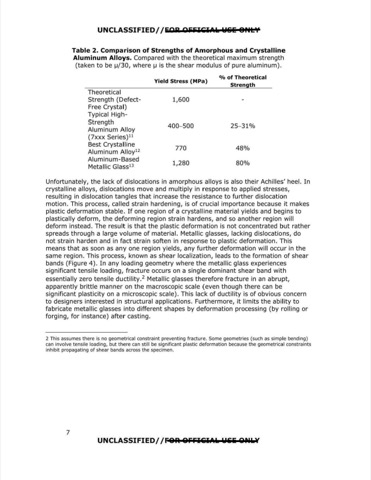
Table 2. Comparison of Strengths of Amorphous and Crystalline
Aluminum Alloys. Compared with the theoretical maximum strength
(taken to be /30, where u is the shear modulus of pure aluminum).
% of Theoretical
Yield Stress (MPa)
Strength
1,600
-
Theoretical
Strength (Defect-
Free Crystal)
Typical High-
Strength
Aluminum Alloy
(7xxx Series)11
Best Crystalline
Aluminum Alloy12
Aluminum-Based
Metallic Glass13
400-500
25-31%
770
1,280
48%
80%
Unfortunately, the lack of dislocations in amorphous alloys is also their Achilles' heel. In
crystalline alloys, dislocations move and multiply in response to applied stresses,
resulting in dislocation tangles that increase the resistance to further dislocation
motion. This process, called strain hardening, is of crucial importance because it makes
plastic deformation stable. If one region of a crystalline material yields and begins to
plastically deform, the deforming region strain hardens, and so another region will
deform instead. The result is that the plastic deformation is not concentrated but rather
spreads through a large volume of material. Metallic glasses, lacking dislocations, do
not strain harden and in fact strain soften in response to plastic deformation. This
means that as soon as any one region yields, any further deformation will occur in the
same region. This process, known as shear localization, leads to the formation of shear
bands (Figure 4). In any loading geometry where the metallic glass experiences
significant tensile loading, fracture occurs on a single dominant shear band with
essentially zero tensile ductility. Metallic glasses therefore fracture in an abrupt,
apparently brittle manner on the macroscopic scale (even though there can be
significant plasticity on a microscopic scale). This lack of ductility is of obvious concern
to designers interested in structural applications. Furthermore, it limits the ability to
fabricate metallic glasses into different shapes by deformation processing (by rolling or
forging, for instance) after casting.
2 This assumes there is no geometrical constraint preventing fracture. Some geometries (such as simple bending)
can involve tensile loading, but there can still be significant plastic deformation because the geometrical constraints
inhibit propagating of shear bands across the specimen.
7
UNCLASSIFIED// FOR OFFICIAL USE ONLY