Text of page 41
MARCH 5, 1948
281
THE AEROPLANE
wing structures as well as for the possibility of housing every-
thing
within a wing
Hence there are very real design reasons for the preference
of disc wings, quite apart from the eased accommodation of
short-span aeroplanes.
Some Remarkable Results
Zimmermann established that the optimum aspect ratio was
found between the values of 0.75 and 1.5.
These values
include both square and circular wing shapes.
For a given
wing section (Clark Y) the latter gave the highest lift coefficient,
1.85 at 45 degrees incidence, compared with a value of 1.24
at 14 degrees incidence for an aspect ratio of six.
Furthermore, an important result was evidence that at an
aspect ratio of unity (square or elliptical wings), and at an
aspect ratio of 0.9 (wing with
faired tips),
no tendency to
autorotation could be found
A circular wing (aspect ratio
of 1.27) indicated the possibility of autorotation (i.e., spinning)
at incidences below that of maximum lift.
The possibility of
spinning before the actual stall is reached is, indeed, extra-
ordinary.
All these results refer to tests with the Clark Y
aerofoil section.
Less established was the contention that disc wings would
give improved lateral and longitudinal stability at low incidences
This seems still to be a moot point of the Flying Saucer.
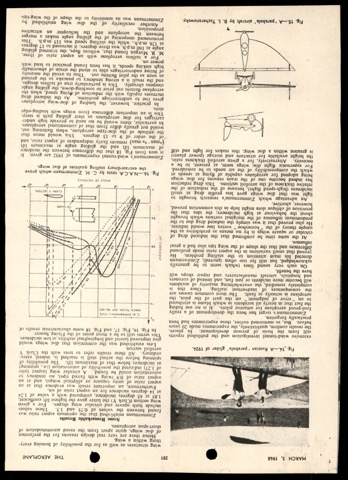
In Fig. 16, Fig. 17, and Fig. 18 some characteristic results of
C. H. ZIMMERMANN'S TESTS
(NACA TECHN. REP No 431
Fig. 14.—A Russian ' parabola' glider of 1924.
extensive wind-tunnel investigation and the published reports
still form
development.
the resulis confirm, qualitatively, the experiments made 20 years
before.
But, as mentioned earlier, these experiments had been
practically forgotten.
Zimmermann's target has been the development of a really
fool-proof aeroplane for amateur pilots.
It is no use hiding
the fact
that in nearly all accidents in which blame is attributed
to an
"error of
judgment "
on
the part of the pilot, the
aeroplane is actually at fault.
The most common causes are
the
consequences
of
inadvertent
stalling
Once this is
completely remedied, the overwhelming majority of accidents
will become mere incidents or just fun, and instead of coroners
and hospitals.
aircraft manufacturers and repair shops will
have the benefit.
On such very sound lines (which seem to be generally
acknowledged, but still far too often ignored). Zimmermann
directed
his
main
attention
the stalling problem.
He
proved that small variations in the aspect ratio made profound
differences and that the shape of the wing tips also had a great
influence.
At the same time he confirmed that the induced drag of
circular or square wings is by no means as prohibitive as the
simple theory of the
"horseshoe" vortex line would indicate.
He also proved that it was simply the induced drag due to the
predominant influence of the marginal vortices which brought
about the behaviour
at high incidences;
the
idea that the
provision of oblique slots might help in this connection proved.
however, abortive.
An
advantage
which Zimmermann's research brought to
light was that disc wings gave less
profile drag at smal
incidences (high-speed flight).
because of the reduction of thi
relative thickness of the aerofoil sections.
This drag reduction
has indeed become one of the
main reasons for disc wings
being adopted for aeroplanes capable of flying at speeds at
which the compressibility of the air needs to be considered
For supersonic flight disc
wings, seem, at present, to be a
necessity.
Alternatively, for a given aerofoil thickness ratio,
he height available for structure and storage (power plants)
is greatest within a disc wing; this makes for light and stifl
LIFT CORERICIENT
IP SHAPE
CLARK Y SECTION
20°
ANGLE OF INCIDENCE
Fig. 16.-N.A.C.A. tests by C. H. Zimmermann which prove
the extraordinary stalling qualities of disc wings.
Zimmermann's wind-tunnel experiments of 1932 are given.
It
is seen from Fig. 18 that the difference between the incidence
of maximum lift and
the gliding
angle
at
maximum lift
(amax- a max) remains fairly independent of aspect ratio, and
of the order of 9 to 13 degrees.
This would mean that
the attitude of the disc-type
aeroplane, when flattening out,
would not greatly differ from that of conventional aeroplanes.
In particular, there would be no need to provide high under-
carriages for disc
aeroplanes as their gliding path is steep.
This is an important difference from wings with leading-edge
slots.
In practice, however, the landing of disc-wing aeroplanes
gives rise to undercarriage problems.
As the induced drag
increases rapidly with the reduction of flying speed, when the
aeroplane flattens out prior to touching-down, the gliding angl
steepens abruptly.
This is particularly true of tailless designs
and the result is a strong tendency to pancake to the ground
as soon as the pilot flattens out.
Thus to avoid the necessity
of fitting undercarriages able to stand the strain of abnormally
high sinking speeds, it has been found practical to land with
power on.
For a tailless aeroplane with an aspect ratio of three.
M. B. Morgan found that, without flaps, the trimmed gliding
angle at 160 m.p.h. was three degrees; it increased to 17 degrees
at 126 m.p.h.. while the stalling speed was 115 m.p.h.
pronounced steepening of the
This
between
the aeroplane and the
proposition.
lidi helicopter akes attracer
an attractive
Fig. 15.-A ' parabola' aircraft by B. I. Tscheranowsky.
Another
peculiarity of the disc wing
established
by
Zimmermann was its sensitivity to the shape of the wing-tips
NND 927545