Text of page 38
FEBRUARY 13, 1948
187
THE AEROPLANE
flight of Kitchen's models.
however.
convinced Cedric
Lee
that an aeroplane of such. design would be a success, and late
in 1910 he acquired the patents.
At the same time, G. Tilghman
Richards, who was a qualified aeronautical engineer, became,
sufficiently interested in the matter to give up
budding
engineering bureau in order to join Cedric Lee and to devote
his energy to the idea of a " safety
" aeroplane.
Tilghman Richards began with systematic experiments on
models and on large gliders.
Later, careful wind-tunnel tests
(including the observation of the pressure distribution) were
made by him in a 2-ft. tunnel he had constructed at East London
College and also in tunnels-of the National Physical Laboratory.
preparation of the design
was,
therefore, uncommonly
careful for this early period of 1911-1914.
In order to appreciate the intentions for the development, the
following quotation from a paper read by Tilghman Richards
about 1912 is illuminating:-
The very fact of high lift occurring at small angles
neans the provision of large area for landing speed resultin
n an inefficient attitude of the plane at high speed: and th
dependence on extraneous controls carried at some distance
from the wing by heavy and redundant structure.
lift at small angles is uscless, likewise high lift/drag ratio at
small angles, and what is required is the reversal of the normal
type of lift curve giving little lift at small angles with low value
of the lift/drag ratio for landing.
Seen from our present state of knowledge and development.
and facing the
burning problems of personal aircraft for the
man in the street, it would seem that this opinion is a very
good argument for further experimentation along the lines
indicated.
The experience with powered aeroplanes was at first beset
with disappointments.
Famine Point, Heysham, was apparently
not a spot from which aeronautical experimenters could derive
any comfort.
The original Kitchen biplane with a 50 b.h.p. rotary engine
was wrecked by a gale, during 1911, before flight tests could
be made.
After reconstruction some flights were performed
with it at Shoreham during 1911-12; yet it never gave any
proof of superior qualities.
The biplane had ailerons of the
original Farman variety, between the wings.
biplane arrangement was given up in favour of the monoplane.
A subsequent experimental monoplane was nicknamed the
" Secret-Circle Plane
or " Doughnut,"
the experiments being
shrouded against publicity (much against the interests of the
development).
This
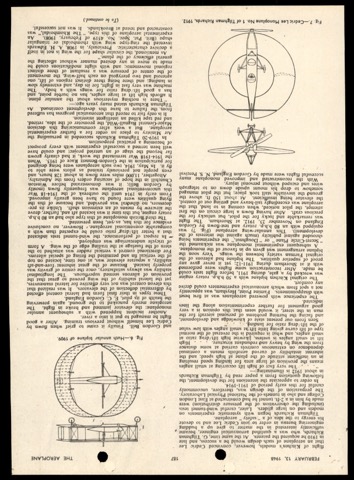
annular-wing aeroplane (Fig.
7) was
equipped with an 80 b.h.p. rotary and test-flown by Gordon
England on
November 23.
1912, at Shoreham.
The flight
was remarkable and lucky for the pilot, but unlucky for the
precious craft.
After having flown a large circuit on the first
attempt, the pilot noticed, when coming in to land, that the
aeroplane was exceedingly tail-heavy and getting out of control.
the elevator being insufficient.
At about 150 ft. above the
ground the inevitable stall took place; but the pilot managed
somehow to drop his mount upside down on to telegraph
wires and escaped without personal injury
With
the
reconstructed
and improved monoplane many
sticcessful flights were made by Gordon England, N. S. Percival
Fig. 6.-Huth annular biplane of 1909.
Fig. 7.—Cedric Lee Monoplane No. 1 of Tilghman Richards, 1912.
and Gordon Bell.
Finally it came to grief when flown by
Cedric Lee himself without previous training. After a good
flight he managed to put it into a river.
Another
incident
happened
with
subsequent
annular
monoplane: the elevator jammed and broke in flight.
The
aeroplane merely pancaked to the ground, again preserving
the health of its pilot, E. C, Gordon England,
These types in their final form had lateral control effected
by differential deflection of the elevators
It was realized that
this elevon control was not very effective for lateral manœuvres,
yet the lateral stability of the wing proved so great that the
provision of ailerons
seemed superfluous.
The longitudinal
stability was always satisfactory, once the centre of gravity was
Because of the great inherent -fore-and-aft
stability, a separate elevator was,
at one time, located on top
of the vertical fin and permitted the fitting of special ailerons
For directional control a vertical rudder
stern of the fuselage at the trailing edge of the wing.
of tricycle undercarriage was employed.
- In respect of performance, the wind-tunnel tests indicated
that a better lift/drag ratio could be expected than with :
comparable conventiona
aeroplane. However, no conclusive
evidence for this has, as yet, been presented
The third British monoplane of this type also had an 80 b.h.p.
rotary engine, but this time it was located aft and, further, drove
the airscrew by means of an extension shaft.
Unlike its pre-
decessors, no dihedral was provided, and because of this the
flying qualities
were found to have been greatly improved.
From early in 1914 until the outbreak of the 1914-18 War
this unconventional aeroplane
by
Gordon
Bell): it
was
lems frequently fore
demonstrated
flown (mostly
Winston
Churchill in the hope of securing
orders from the Admiralty,
Altogether, 11,000 miles were flown in about 128 hours, and
even people not
previously trained as pilots were able t
fly it.
In May, 1914, two such aeroplanes were being designe
for participation in the Gordon-Bennett Race of 1915.
When
the 1914-1918 War terminated the work. it had clearly grown
far beyond the
stage of an untried project and
could have
well been termed a successful experiment with every prospect
of becoming a practical proposition
In 1919-20 Tilghman Richards succeeded in persuading the
Air Ministry to place an order for a further experimental
after
communicating this decision
Major-General Bagnall-Wild, the promoter of the idea, retired,
and red tape killed an intelligent intention.
It is only fair to record that aeronautical progress has suffered
from. the failure to have this development continued.
Tilghman Richards stated many years ago:
There is nothing mysterious about
the annular plane.
It affords high lift at large angles.
lift/drag ratio for
machine was very fast in flight, for its day, and extremely slow
in landing: and there being three distinct regions of lift, one
apteroid and two pterygoid on each half-wing
pressure was a resultant of three distinct
regional movements; and with
slight modifications could be
made to move in any desired
manner without affecting the
general efficiency of the plane."
As mentioned, the circular shape for the wing is not in itself
a decisive characteristic.
Previously, in 1908.
A. H. Edwards
invented the ring-type wing
with
rhomboidal or triangular
shape (Brit. Pat. Spec. No.
4519 of February, 1908).
experimental aeroplane of this type,
An
"The Rhomboidal," was
constructed and tested at Brooklands. It was not successful.
(To be continued.)
NND 927545