DOW-UAP-D056
Range Fouler Debrief, Arabian Sea, August 2020
- Agency
- Department of War
- Format
- Document, 1 page
- Incident date
- 8/24/20
- Place
- Arabian Sea
- Released
- Release 01, May 8, 2026
- Source
- war.gov
Description from war.gov
Redactions war.gov lists this record as redacted. Withheld material is blacked out in the file itself.
Page 1
Range Fouler Debrief Form Declassified by MG Richard A. Harrison uscElease de not use the purple Decla"submit" button above a Save and email the complete file manually (see below). Please complete this form to the best of your ability. If you do not have the requested information, please leave the field blank. If there was more than one "group," please report each on a separate form for data collection purposes. You should receive a response within 5 business days. Last Name, First Name Rank Squadron SIPR Email Address Crew Position 0-3 HSM-73 Pilot This information is for contact only. SPEAR sanitizes all reports of identifying information. Absolutely no identifying information for aircrew or squadron will be recorded for analysis. 08/24/20 Date (mm/dd/vy) 00:04:30 Time of detection (hh;mm:ss Z) Night Day / Night 705 Side No. 168122 Buno SSC No Mission Description (CAS, BFM, etc) LFE? 21440 21440 1.4a Contact Working Area Contact Latitute N/S Contact Longitude EW (Ex: W-72 1A) (DD:MM:SS) (DD:MM:SS) Please attempt to determine a Lat / Long for the contact at initial detection. We recommend using JMPS to reference the sensor-derived bearing and range relative to the bullseye you had in use. If that method is not available, any reasonable derivation of location will work, but please be as specific as possible and make a note in the comments section. These locations may be used to cue other means of tracking. Contact Altitude (Ex: 22000) Yes Altitude Constant? 310 Wind Dir at Contact Alt (From) Was the contact moving? 5 Wind Speed Yes Direction/Speed (Ex. 090/15) 270/UNK Radar Equipped: Other Stable Trackfile?: No # of Contacts in "Group": 3 EA Indications (Check all that apply): AlM-9x Self-Track: ATFLIR Autotrack: Tally Achieved: ECM Arc Letter Identifier False Trackfiles Other/ Ambiguous Please check all that apply: Round: Moving Parts: Square: Metallic: Balloon-shaped: Markings: Wings/Airframe: Translucent: Other Shape: Opaque: Apparent Propuision: Reflective: Please use the field below to describe the contact and any interaction in your own words with as much detail as possible. Please be sure to include any detail not included in questions above. observed 3x possible unidentified small air contacts while conducting routine operations in the North Arabian Sea. Negative ES, radar track, and IFF track. Distance to contact was unknown. Speed of contact was unknown. Precise course of contact was unknown, but appeared to be on a westerly heading. No interaction took place between and the unknown air contacts. Initially observed 1x unknown air contact and tracked it before losing sight as it went behind a cloud. When contact on the unknown air contact was regained, 2x additional unknown air contacts were seen due east of the location of the initial contact. All 3x unknown air contacts appeared to maintain their relative course, speed, and altitude. Don't use the purple "submit" button! Save this form with filename "Date _Squadron_RF.pdf" and email it to (b)(6) (Also in the global). For troubleshooting, call (b)6) Thank you for your time. Please ensure all display tapes are ripped for the entire time of interaction and saved as a .wmv (Example: 4 May VFA-106 HUD.wmv). Squadron intel personnel shall upload those files to the repository located at this link. (b)(6) USCENTCOM MDR 26-0038 to 26-0046 Approved for Release to AARO 03/27/26 000001The text is machine-read (OCR) from the scan and can contain errors. The scan is the record.
Machine summary
Written by Claude Sonnet 4.6 (Anthropic) on May 22, 2026, from the record's text and war.gov's description. It is not part of the record and can contain errors; check it against the document.
This record is a U.S. Navy Range Fouler Debrief Form dated August 24, 2020, submitted by a pilot assigned to HSM-73 (an active-duty helicopter maritime strike squadron). The incident occurred at approximately 00:04:30 Zulu over the North Arabian Sea during routine operations. The reporting pilot observed three small unidentified air contacts described as having wings or airframe structure, initially on a westerly heading. The pilot tracked one contact before losing it behind a cloud; upon reacquisition, two additional contacts were visible to the east. All three objects appeared to hold consistent course, speed, and altitude. No radar track, electronic support, or IFF returns were obtained.
The form was collected by SPEAR, the Navy's standardized UAP reporting mechanism, and was later released through USCENTCOM MDR 26-0038 to 26-0046 and approved for release to AARO. Identifying information for the aircrew has been sanitized per standard SPEAR protocol. The absence of any sensor corroboration — no radar, no IFF, no ES — limits what can be confirmed beyond the visual observation. The report is notable for occurring in an active operational area and involving a formation of three objects rather than a single contact.
Most frequent words
Select one to highlight it in the text above.
Related records
Similar records 8
Closest matches by the text of the documents.
-
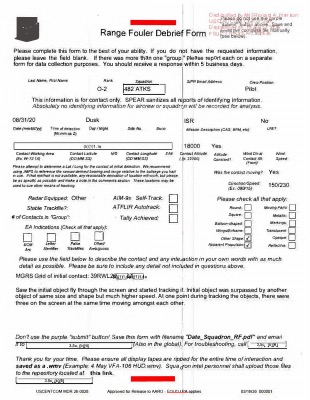 DOW-UAP-D042 Range Fouler Debrief, Arabian Gulf, 2023
8/31/20
-
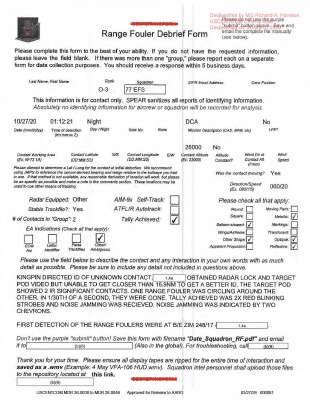 DOW-UAP-D058 Range Fouler Debrief, NA, October 2020
10/27/20
-
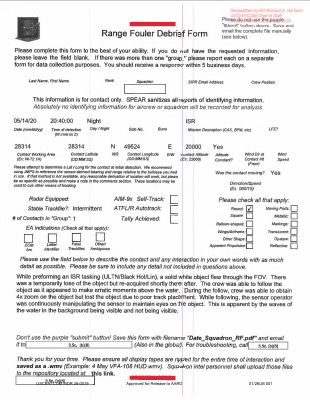 DOW-UAP-D038 Range Fouler Debrief, Middle East, May 2020
5/14/20
-
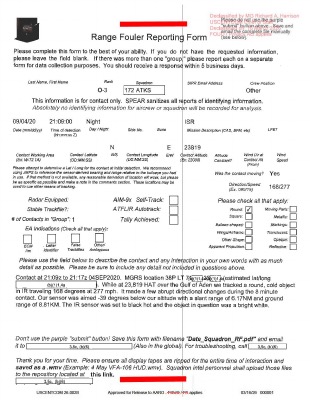 DOW-UAP-D057 Range Fouler Reporting Form, Gulf of Aden, September 2020
9/4/20
-
 DOW-UAP-D089 Range Fouler Debrief, Eastern United States, 2020
2020
-
 DOW-UAP-D044 Range Fouler Reporting Form, Gulf of Aden, October 2020
10/15/20
-
 DOW-UAP-D091 Range Fouler Debrief, Atlantic Ocean, 2020
2020
-
 DOW-UAP-D090 Range Fouler Debrief, Eastern United States, 2019
2019