CIA-UAP-003

The Central Intelligence Agency and Overhead Reconnaissance; The U-2 and OXCART Programs, 1954-1974, page 63

One page of a U.S. government record released under PURSUE, shown on its own with its text. The record page has the whole document, its catalog details and the scan.

Page
63 of 406
Agency
CIA
Released
Release 03, June 12, 2026

Text of page 63

-Seeret NeFORN Chapter 2 50 James G. Baker The first success in designing very-high-acuity lenses came in the mid-1940s, when James G. Baker of Harvard and Richard S. Perkin of the Perkin-Elmer (P-E) Company of Norwalk, Connecticut, collaborated on a design for an experimental camera for the Army Air Force. They developed a 48-inch focal-length scanning camera that was mounted in a modified B-36 bomber. When tested over Fort Worth, Texas, at 34,000 feet, the new camera produced photographs in which two golf balls on a putting green could be distinguished (in reality, however, the "golf balls" were 3 inches in diameter). These photographs demonstrated the high acuity of Baker's lens, but the camera weighed more than a ton and was much too large to be carried aloft in an aircraft as small as the U-2. Realizing that size and weight were the major restraining factors in developing a camera for the U-2, James Baker began working on a radically new system in October 1954, even before the CIA adopted the Lockheed proposal. Baker quickly recognized, however, that he would need almost a year to produce a working model of such a com- plex camera. Since Kelly Johnson had promised to have a U-2 in the air within eight months, Baker needed to find an existing camera that could be used until the new camera was ready. After consulting with his friend and colleague Richard Perkin, Baker decided to adapt for the U-2 an Air Force camera known as the K-38, a 24-inch aerial framing camera built by the Hycon Manufacturing Company of Pasadena, California. Perkin suggested modifying several standard K-38 cameras in order to reduce their weight to the U-2's 450-pound payload limit. At the same time, Baker would make critical adjustments to existing K-38 lenses to improve their acuity. Baker was able to do this in a few weeks, so several modified K-38s, now known as A-1 cameras, were ready when the first "Angel" aircraft took to the air in mid-1955.'5 CIA awarded Hycon a contract for the modified K-38 cameras, and Hycon, in turn, subcontracted to Perkin-Elmer to provide new lenses and to make other modifications to the cameras in order to make them less bulky. In its turn, Perkin-Elmer subcontracted to Baker to rework the existing K-38 lenses and later design an im- proved lens system. To keep his lens-designing efforts separate from is Ibid. -Seeret

Machine-read (OCR) from the scan by this archive; it can contain errors. The scan is the record.
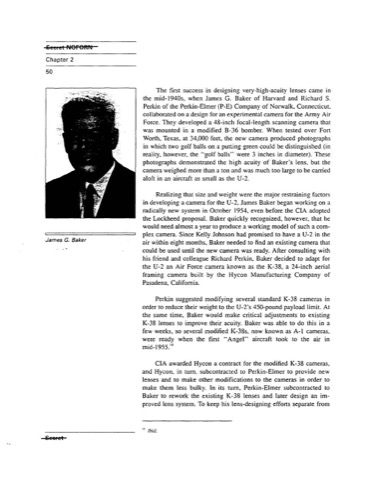
Image from page 63 of CIA-UAP-003, as released by war.gov
Image from page 63 of the PDF. Open the scan to see the whole page.

Cite this page

Central Intelligence Agency. "The Central Intelligence Agency and Overhead Reconnaissance; The U-2 and OXCART Programs, 1954-1974" (CIA-UAP-003). PURSUE Release 03, U.S. Department of War, June 12, 2026. https://www.war.gov/medialink/ufo/061226/release_03/documents/CIA-UAP-003-THE_CENTRAL_INTELLIGENCE_AGENCY_AND_OVERHEAD_RECONNAISSANCE-THE_U-2_AND_OXCART_PROGRAMS_1954-1974.pdf. Declassified UAP, page 63, https://declassifieduap.org/r/cia-uap-003-the-central-intelligence-agency-and-overhead-reconnaissance-the-u-2-and-oxcart-programs-1954-1974/p/63. Accessed November 28, 2026.

This address shows page 63 on its own; /r/cia-uap-003-the-central-intelligence-agency-and-overhead-reconnaissance-the-u-2-and-oxcart-programs-1954-1974?page=63 opens the same page in the full reader. Both stay. How to cite.