CIA-UAP-003

The Central Intelligence Agency and Overhead Reconnaissance; The U-2 and OXCART Programs, 1954-1974, page 62

One page of a U.S. government record released under PURSUE, shown on its own with its text. The record page has the whole document, its catalog details and the scan.

Page
62 of 406
Agency
CIA
Released
Release 03, June 12, 2026

Text of page 62

Secret NOFORN Chapter 2 49 engine, but no firm plans existed for the all-important cameras. Existing cameras were too bulky and lacked sufficient resolution to be used in high-altitude reconnaissance. U-2 landing gear and pogos The workhorses of World War II aerial photography had been the Fairchild K-19 and K-21 framing cameras with lenses of varying focal lengths from 24 to 40 inches. Late in the war, the trimetrogon K-17 mapping-camera system came into use. This system consisted of three separate cameras which made three photographs simultaneously: a vertical, an oblique to the left, and an oblique to the right. The major shortcomings of the trimetrogon system were the large amount of film required and the system's lack of sharp definition on the obliques. The standard aerial cameras available in the early 1950s could achieve resolutions of about 20 to 25 feet (7 to 8 meters) on a side when used at an altitude of 33,000 feet (10,000 meters), or about 25 lines per millimeter in current terms of reference. Such resolution was camera with a resolution of only 20 to 25 feet at a height of 33,000 feet was too crude to be used at twice that altitude. Indeed, for intelli- gence purposes a resolution of less than 10 feet was necessary to dis- cern smaller targets in greater detail. This meant that any camera carried to altitudes above 68, 000 feet had to be almost four times a‹ good as existing aerial cameras in order to achieve a resolution of less than 10 feet. As a result, some scientists doubted that useful photogra- phy could be obtained from altitudes higher than 40,000 feet.'* " Baker interview (S). Secret

Machine-read (OCR) from the scan by this archive; it can contain errors. The scan is the record.
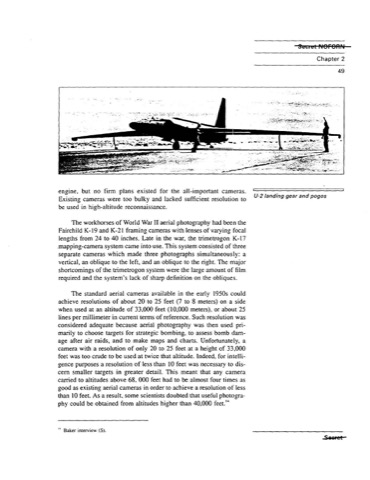
Image from page 62 of CIA-UAP-003, as released by war.gov
Image from page 62 of the PDF. Open the scan to see the whole page.

Cite this page

Central Intelligence Agency. "The Central Intelligence Agency and Overhead Reconnaissance; The U-2 and OXCART Programs, 1954-1974" (CIA-UAP-003). PURSUE Release 03, U.S. Department of War, June 12, 2026. https://www.war.gov/medialink/ufo/061226/release_03/documents/CIA-UAP-003-THE_CENTRAL_INTELLIGENCE_AGENCY_AND_OVERHEAD_RECONNAISSANCE-THE_U-2_AND_OXCART_PROGRAMS_1954-1974.pdf. Declassified UAP, page 62, https://declassifieduap.org/r/cia-uap-003-the-central-intelligence-agency-and-overhead-reconnaissance-the-u-2-and-oxcart-programs-1954-1974/p/62. Accessed November 28, 2026.

This address shows page 62 on its own; /r/cia-uap-003-the-central-intelligence-agency-and-overhead-reconnaissance-the-u-2-and-oxcart-programs-1954-1974?page=62 opens the same page in the full reader. Both stay. How to cite.