CIA-UAP-003

The Central Intelligence Agency and Overhead Reconnaissance; The U-2 and OXCART Programs, 1954-1974, page 28

One page of a U.S. government record released under PURSUE, shown on its own with its text. The record page has the whole document, its catalog details and the scan.

Page
28 of 406
Agency
CIA
Released
Release 03, June 12, 2026

Text of page 28

mainly with XF-104 jigs and designs. ... The prototype of this plane can be produced within a year from the date of order: Five planes could be delivered for operations within two years. The Bell proposal is a more conventional aircraft having nor- mal landing gear. As a result, its maximum altitude over target is 69,500 feet and the speed and range are not as good as the Lockheed CL-282.33 Gardner's enthusiasm for the CL-282 had given Strong the false impression that most Air Force officials supported the Lockheed de- sign. In reality, the Air Force's uniformed hierarchy was in the pro- cess of choosing the modified version of the Martin B-57 and the new Bell X-16 to meet future reconnaissance needs. During their meeting with Strong, Trevor Gardner, Frederick Ayer, and Garrison Norton explained that they favored the CL-282 because it gave promise of flying higher than the other designs and because at maximum altitude its smaller radar cross section might make it invisible to existing Soviet radars. The three officials asked Strong if the CIA would be interested in such an aircraft. Strong promised to talk to the Director of Central Intelligence's newly hired Special Assistant for Planning and Coordination, Richard M. Bissell, Jr., about possible Agency interest in the CL-282.** Richard Bissell had already had an active and varied career be- fore he joined the CIA. A graduate of Groton and Yale, Bissell stud- ied at the London School of Economics for a year and then completed a doctorate at Yale in 1939. He taught economics, first at Yale and then from 1942 at the Massachusetts Institute of Technology (MIT), where he became a full professor in 1948. During World War II, Bissell had managed American shipping as executive fficer of the Combined Shipping Adjustment Board. After the wa e served as deputy director of the Marshall Plan from 1948 until th end of 195l, when he became a staff member of the Ford Foundation. His first association with the Agency came in late 1953, when he undertook a contract study of possible responses the United * Philip G. Strong. Memorandum for the Record. "Special Aircraft for Penetration Photo Reconnaissance.* 12 May 1954. OSI records (now in OSWR), job 80R-01424. box 1 (S). * Karl H. Weber. The Office of Scientific Intelligence, 1949.68. Directorate of Science and Technology Historical Series OSI-I (CIA: DS&T. 1972), vol. L. tab A. pp. 16- 17 (TS Codeword). -Secret NOFORN Chapter 1 15 Philip Strong -Seeret-

Machine-read (OCR) from the scan by this archive; it can contain errors. The scan is the record.
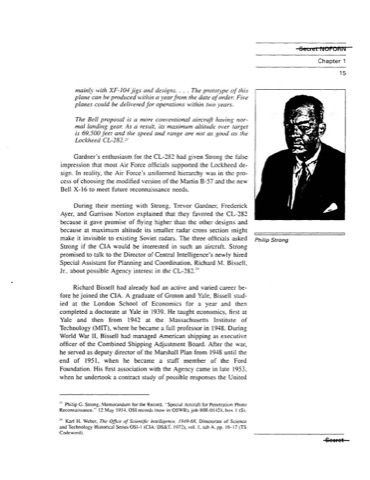
Image from page 28 of CIA-UAP-003, as released by war.gov
Image from page 28 of the PDF. Open the scan to see the whole page.

Cite this page

Central Intelligence Agency. "The Central Intelligence Agency and Overhead Reconnaissance; The U-2 and OXCART Programs, 1954-1974" (CIA-UAP-003). PURSUE Release 03, U.S. Department of War, June 12, 2026. https://www.war.gov/medialink/ufo/061226/release_03/documents/CIA-UAP-003-THE_CENTRAL_INTELLIGENCE_AGENCY_AND_OVERHEAD_RECONNAISSANCE-THE_U-2_AND_OXCART_PROGRAMS_1954-1974.pdf. Declassified UAP, page 28, https://declassifieduap.org/r/cia-uap-003-the-central-intelligence-agency-and-overhead-reconnaissance-the-u-2-and-oxcart-programs-1954-1974/p/28. Accessed November 28, 2026.

This address shows page 28 on its own; /r/cia-uap-003-the-central-intelligence-agency-and-overhead-reconnaissance-the-u-2-and-oxcart-programs-1954-1974?page=28 opens the same page in the full reader. Both stay. How to cite.