CIA-UAP-003

The Central Intelligence Agency and Overhead Reconnaissance; The U-2 and OXCART Programs, 1954-1974, page 27

One page of a U.S. government record released under PURSUE, shown on its own with its text. The record page has the whole document, its catalog details and the scan.

Page
27 of 406
Agency
CIA
Released
Release 03, June 12, 2026

Text of page 27

Secret NeFeRN Chapter 1 14 Trevor Gardner design showed the most promise for reconnaissance of the Soviet Union. This belief was shared by Gardner's special assistant. Frederick Ayer, Jr., and Garrison Norton, an adviser to Secretary Talbott." According to Norton, Gardner tried to interest SAC commander LeMay in the Lockheed aircraft because Gardner envisioned it pri- marily as a collector of strategie, rather than tactical, intelligence. But General LeMay had already shown that he was not interested in an unarmed aircraft. Gardner, Ayer, and Norton then decided to seek CIA support for the high-flying aircraft. At that time the Agency's official involvement in overhead reconnaissance was limited to advising the Air Force on the problems of launching large camera-carrying bal- loons for reconnaissance flights over hostile territory (for the details of this program, see chapter 2). The Chief of the Operations Staff in the Office of Scientific Intelligence, Philip G. Strong. however, served on several Air Force advisory boards and kept himself well in- formed on developments in reconnaissance aircraft." Gardner, Norton, and Ayer met with Strong in the Pentagon on 12 May 1954. six days before the Wright Air Development Command began to evaluate the Lockheed proposal. Gardner described Kelly Johnson's proposal and showed the drawings to Strong. After this meeting. Strong summarized his impressions of the Air Force's search for a high-altitude reconnaissance aircraft: Proposals for special reconnaissance aircraft have been re- ceived in the Air Staff from Lockheed. Fairchild, and Bell. ... The Lockheed proposal is considered to be the best. It has been given the type designation of CL-282 and in many respects is a jet-powered glider based essentially on the Lockheed Day Fighter XF-104. It is primarilv subsonic but can attain transonic speeds over the target with a consequent loss of range. With an altitude of 73,000 feet over the target it has a combat radius of 1,400 nautical miles. ... The CL-282 can be manufactured * Garrison Norton, interview by Donald E. Weizenbach, tape recording. Washington. DC. 23 May 1983 (S): Michael R. Beschloss. Mavday: Eisenhower. Khrushchev and the U-2 Affair (New York: Harper & Row, 1986). p. 79. * Strong was a colonel in the Marine Corps Reserve and often used that title even though he was not on active duty. He later advanced to the rank of brigadier general in the reserve. For Strong's contacts with senior Air Force officials concerning the CL-282, see the Norton interview (S). Seeret

Machine-read (OCR) from the scan by this archive; it can contain errors. The scan is the record.
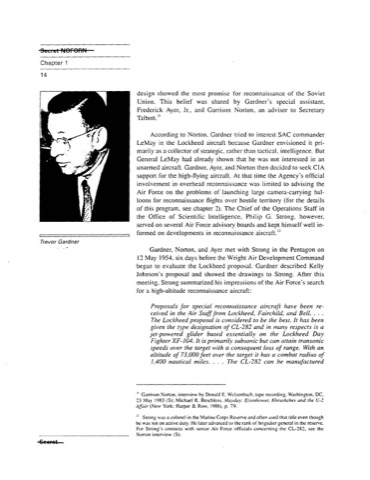
Image from page 27 of CIA-UAP-003, as released by war.gov
Image from page 27 of the PDF. Open the scan to see the whole page.

Cite this page

Central Intelligence Agency. "The Central Intelligence Agency and Overhead Reconnaissance; The U-2 and OXCART Programs, 1954-1974" (CIA-UAP-003). PURSUE Release 03, U.S. Department of War, June 12, 2026. https://www.war.gov/medialink/ufo/061226/release_03/documents/CIA-UAP-003-THE_CENTRAL_INTELLIGENCE_AGENCY_AND_OVERHEAD_RECONNAISSANCE-THE_U-2_AND_OXCART_PROGRAMS_1954-1974.pdf. Declassified UAP, page 27, https://declassifieduap.org/r/cia-uap-003-the-central-intelligence-agency-and-overhead-reconnaissance-the-u-2-and-oxcart-programs-1954-1974/p/27. Accessed November 28, 2026.

This address shows page 27 on its own; /r/cia-uap-003-the-central-intelligence-agency-and-overhead-reconnaissance-the-u-2-and-oxcart-programs-1954-1974?page=27 opens the same page in the full reader. Both stay. How to cite.