CIA-UAP-003

The Central Intelligence Agency and Overhead Reconnaissance; The U-2 and OXCART Programs, 1954-1974, page 24

One page of a U.S. government record released under PURSUE, shown on its own with its text. The record page has the whole document, its catalog details and the scan.

Page
24 of 406
Agency
CIA
Released
Release 03, June 12, 2026

Text of page 24

gravity (g's) instead of the military specification strength of 5.33 g's. For the power plant he selected the General Electric J73/GE-3 nonaf- terburning turbojet engine with 9,300 pounds of thrust (this was the same engine he had chosen for the F-104, which had been the basis for the U-2 design)."* Many of the CL-282's design features were adapted from gliders. Thus, the wings and tail were detachable. Instead of a conventional landing gear, Johnson proposed using two skis and a reinforced belly rib for landing—a common sailplane technique-and a jettisonable wheeled dolly for takeoff. Other fea- tures included an unpressurized cockpit and a 15-cubic-foot payload area that could accommodate 600 pounds of sensors. The CL-282's maximum altitude would be just over 70,000 feet with a 2, 000-mile range. Essentially, Kelly Johnson had designed a jet-propelled glider. 's Early in March 1954, Kelly Johnson submitted the CL-282 de- sign to Brig. Gen. Bernard A. Schriever's Office of Development Planning. Eugene Kiefer and Bud Wienberg studied the design and recommended it to General Schriever, who then asked Lockheed to submit a specific proposal. In early April, Kelly Johnson presented a full description of the CL-282 and a proposal for the construction and maintenance of 30 aircraft to a group of senior Pentagon officials that included Schriever's superior. Lt. Gen. Donald L. Putt, Deputy Chief of Staff for Development, and Trevor N. Gardner, Special Assistant for Research and Development to the Secretary of the Air Force. Afterward Kelly Johnson noted that the civilian officials were very much interested in his design but the generals were not." The CL-282 design was also presented to the commander of the Strategic Air Command (SAC), Gen. Curtis E. LeMay, in early April by Eugene Kiefer, Bud Wienberg, and Burton Klein from the Oftice of " Lockheed Corporation. "Strategic Reconnaissance and Intelligence." Development Planning Note #1, 30 November 1953 (U). " Miller, Lockheed U-2. p. 12. For more details on Kelly Johnson's original proposal. see Profile of CL-282 High Altitude Aircraft prepared by Lockheed Aircratt * Kelly Johnson Papers. "Log for Project X." April 1954. Lockheed Corporation. Advanced Development Projects Division, Burbank, California. Secret NOFORN Chapter 1 11 Kelly Johnson Secret

Machine-read (OCR) from the scan by this archive; it can contain errors. The scan is the record.
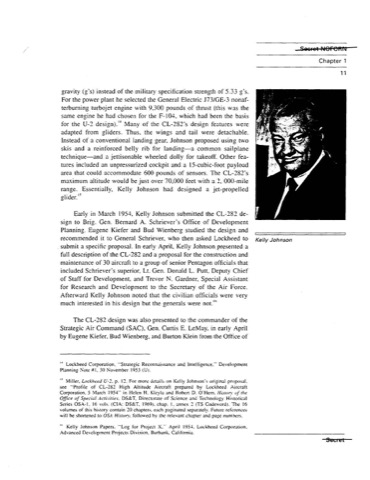
Image from page 24 of CIA-UAP-003, as released by war.gov
Image from page 24 of the PDF. Open the scan to see the whole page.

Cite this page

Central Intelligence Agency. "The Central Intelligence Agency and Overhead Reconnaissance; The U-2 and OXCART Programs, 1954-1974" (CIA-UAP-003). PURSUE Release 03, U.S. Department of War, June 12, 2026. https://www.war.gov/medialink/ufo/061226/release_03/documents/CIA-UAP-003-THE_CENTRAL_INTELLIGENCE_AGENCY_AND_OVERHEAD_RECONNAISSANCE-THE_U-2_AND_OXCART_PROGRAMS_1954-1974.pdf. Declassified UAP, page 24, https://declassifieduap.org/r/cia-uap-003-the-central-intelligence-agency-and-overhead-reconnaissance-the-u-2-and-oxcart-programs-1954-1974/p/24. Accessed November 28, 2026.

This address shows page 24 on its own; /r/cia-uap-003-the-central-intelligence-agency-and-overhead-reconnaissance-the-u-2-and-oxcart-programs-1954-1974?page=24 opens the same page in the full reader. Both stay. How to cite.