CIA-UAP-003

The Central Intelligence Agency and Overhead Reconnaissance; The U-2 and OXCART Programs, 1954-1974, page 23

One page of a U.S. government record released under PURSUE, shown on its own with its text. The record page has the whole document, its catalog details and the scan.

Page
23 of 406
Agency
CIA
Released
Release 03, June 12, 2026

Text of page 23

Secret NOFORN Chapter 1 10 MX-2147 FARCHI. D Designs for the Air Force competition for a high-altitude reconnaissance aircraft Seeret MX-2147 BELL MARTIN MODEL 284 Lockheed also submit a design. Carter noted that the proposed aircraft would have to reach altitudes of between 65. 000 and 70,000 feet and correctly forecast, "If extreme altitude performance can be realized in a practical aircraft at speeds in the vicinity of Mach 0.8, it should be capable of avoiding virtually all Russian defenses until about 1960.* Carter added, "To achieve these characteristics in an aircraft which will have a reasonably useful operational life during the period before 1960 will, of course, require very strenuous efforts and extraordinary procedures, as well as nonstandard design philosophy." Some of the "nonstandard" design characteristics suggested by Carter were the elimination of landing gear, the disregard of military specifications. and the use of very low load factors. Carter's memorandum closed with a warning that time was of the essence: "In order that this spe- cial aircraft can have a reasonably long and useful life, it is obvious that its development must be greatly accelerated beyond that consid- ered normal.* 11 Lockheed's senior officials approved Carter's proposal, and early in 1954 the corporation's best aircraft designer-Clarence L. (Kelly) Johnson-began working on the project, then known as the CL -282 but later to become famous under its Air Force designator— the U-2. Already one of the world's leading aeronautical engineers. Kelly Johnson had many successful military and civilian designs to his credit. including the P-38, P-80, F-104, and Constellation. Johnson quickly came up with a radical design based upon the fuselage of the F-104 jet fighter but incorporating a high-aspect-ratio ailplane wing. To save weight and thereby increase the aircraft's al rude Johnson decided to stress the airframe to only 2.5 units o " Miller. Lockheed U-2. p. 12.

Machine-read (OCR) from the scan by this archive; it can contain errors. The scan is the record.
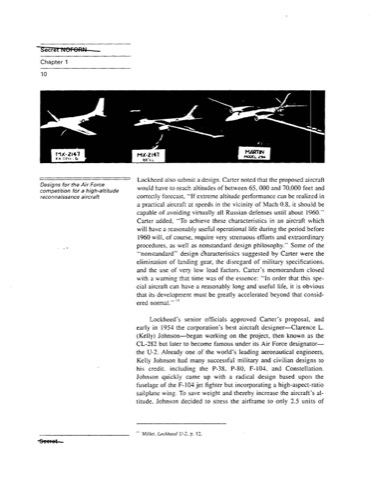
Image from page 23 of CIA-UAP-003, as released by war.gov
Image from page 23 of the PDF. Open the scan to see the whole page.

Cite this page

Central Intelligence Agency. "The Central Intelligence Agency and Overhead Reconnaissance; The U-2 and OXCART Programs, 1954-1974" (CIA-UAP-003). PURSUE Release 03, U.S. Department of War, June 12, 2026. https://www.war.gov/medialink/ufo/061226/release_03/documents/CIA-UAP-003-THE_CENTRAL_INTELLIGENCE_AGENCY_AND_OVERHEAD_RECONNAISSANCE-THE_U-2_AND_OXCART_PROGRAMS_1954-1974.pdf. Declassified UAP, page 23, https://declassifieduap.org/r/cia-uap-003-the-central-intelligence-agency-and-overhead-reconnaissance-the-u-2-and-oxcart-programs-1954-1974/p/23. Accessed November 28, 2026.

This address shows page 23 on its own; /r/cia-uap-003-the-central-intelligence-agency-and-overhead-reconnaissance-the-u-2-and-oxcart-programs-1954-1974?page=23 opens the same page in the full reader. Both stay. How to cite.