Text of page 8
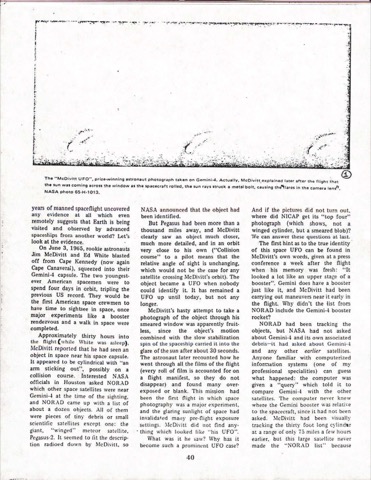
The "McDivitt UFO", prize-winning astronaut photograph taken on Gemini-4. Actually, McDivitt explained later after the flight that
the sun was coming across the window as the spacecraft rolled, the sun rays struck a metal bolt, causing the"lares in the camera lens".
NASA photo 65-H-1013.
years of manned spaceflight uncovered
remotely suggests that Earth is being
observed by advanced
spaceships from another world? Let's
look at the evidence.
On June 3, 1965, rookie astronauts
Jim McDivitt and Ed White blasted
off from Cape Kennedy (now again
Cape Canaverai), squeezed into their
Gemini-4 capsule. The two youngest-
spend four days in orbit, tripling the
previous US record. They would be
the first American space crewmen to
have time to sightsee in space, once
major experiments like a booster
rendezvous and a walk in space were
Approximately thirty hours into
the fight (while White was asleep),
McDivitt reported that he had seen an
object in space near his space capsule.
It appeared to be cylindrical with *an
arm
sticking out", possibly on a
collision course.
Interested NASA
officials in Houston asked NORAD
which other space satellites were near
Gemini-4 at the time of the sighting,
and NORAD came up with a list of
about a dozen objects. All of them
were pieces of tiny debris or small
scientific
satellites except one: the
giant,
"winged" meteor satellite.
Pegasus-2. It seemed to fit the descrip-
tion radioed down by McDivitt, so
NASA announced that the object had
been identified
But Pegasus had been more than a
thousand miles away, and McDivitt
clearly saw an object much closer,
much more detailed, and in an orbit
very close to his own ("Collision
course" to a pilot means that the
relative angle of sight is unchanging,
which would not be the case for any
satellite crossing McDivitt's orbit). The
object became a UFO when nobody
could identify it. It has remained a
UFO up until today, but not any
longer.
McDivitt's hasty attempt to take a
photograph of the object through his
smeared window was apparently fruit-
less,
since
the object's
motion
combined with the slow stabilization
spin of the spaceship carried it into the
glare of the sun after about 30 seconds.
The astronaut later recounted how he
went through all the films of the flight
(every roll of film is accounted for on
a flight manifest, so they do not
disappear) and
found many over-
exposed or blank. This mission had
ản to hang ha
been the first flight in which space
photography was a major experiment,
and the glaring sunlight of space had
invalidated many pre-flight exposure
settings. MeDivitt did not find any-
• thing which looked like "his UFO".
What was it he saw? Why has it
become such a prominent UFO case?
40
And if the pictures did not turn out,
where did NICAP get its "top four"
photograph (which shows, not a
winged cylinder, but a smeared blob)?
We can answer these questions at last.
The first hint as to the true identity
of this space UFO can be found in
McDivitt's own words, given at a press
conference a week after the flight
when his
memory was fresh: "It
looked a lot like an upper stage of a
booster". Gemini does have a booster
just like it, and MeDivitt had been
carrying out maneuvers near it early in
the flight. Why didn't the list from
NORAD include the Gemini-4 booster
rocket?
NORAD had been tracking the
objects, but NASA had not asked
about Gemini-4 and its own associated
debris- it had asked about Gemini-4
and
any other earlier satellites.
Anyone
familiar with computerized
information systems (one of
my
professional specialities) can guess
what happened: the computer was
given a "query" which told it to
compare Gemini-4 with the other
satellites. The computer never knew
where the Gemini booster was relative
to the spacecraft, since it had not been
asked. McDivitt
had
been visually
tracking the thirty foot long cylinder
at a range of only 75 miles a few hours
earlier, but this large satellite never
made
the "NORAD list" because