NASA-UAP-D015

Astronaut Scientific Debriefings, 1962-1963, page 6

One page of a U.S. government record released under PURSUE, shown on its own with its text. The record page has the whole document, its catalog details and the scan.

Page
6 of 216
Agency
NASA
Released
Release 03, June 12, 2026

Text of page 6

This aldn't seen to be any problem. Looking up fairly close to the moom, I would guess a--counting a nunber degrees probably, you could see right up to the edge of the moon. The stars would be Vistble right up--very elose, its not 11ke It is when-Eyou absenue the mson Suer the scuthis surface ] Pahly faint stars? Tes, I think so, Just like the other--the whole field of stars you're looking at, you come up and--the only way, when you swing the capsule around and you'd be approaching INX area where the noon was, you could tell it because there would be moonlight coming in the window and you would see the Light noving aeross on the capsule. & and thats the only way you would know that you're really coming close to the mooa. You didn't know it by the sky getting & real light as you cove to the node like you do here. There was a little area around It where this was true. It wasn't just/complete eutoff, but it was nothing like the butldup we have here where you are looking through the atrosphere and get all thie. Deattermy Any Comets? No. lo comets. I used the first sunset. I had this little poloroid filter out were were going to use so that we could look directly at the sun. This, while I think of it, this was another thing that was rather surprising to me. The sun is not as blinding as I thought it would be. I told the people in debriefing down there after experimenting very carefully with this a little bit, I looked directly at the sun with the naied eye just as you would do here. Xou've looted up and squinted so that you have really shielded your eyes and looked directly a t the mn/a little aliver of light through. And

Machine-read (OCR) from the scan by this archive; it can contain errors. The scan is the record.
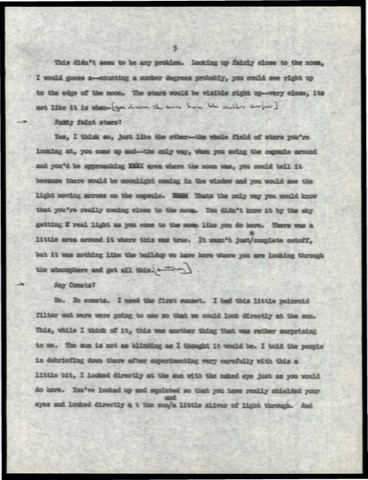
Image from page 6 of NASA-UAP-D015, as released by war.gov
Image from page 6 of the PDF. Open the scan to see the whole page.

Cite this page

National Aeronautics and Space Administration. "Astronaut Scientific Debriefings, 1962-1963" (NASA-UAP-D015). PURSUE Release 03, U.S. Department of War, June 12, 2026. https://www.war.gov/medialink/ufo/061226/release_03/documents/NASA-UAP-D015_Astronaut-Scientific-Debriefings_1962-1963.pdf. Declassified UAP, page 6, https://declassifieduap.org/r/nasa-uap-d015-astronaut-scientific-debriefings-1962-1963/p/6. Accessed November 28, 2026.

This address shows page 6 on its own; /r/nasa-uap-d015-astronaut-scientific-debriefings-1962-1963?page=6 opens the same page in the full reader. Both stay. How to cite.