NASA-UAP-D015

Astronaut Scientific Debriefings, 1962-1963, page 57

One page of a U.S. government record released under PURSUE, shown on its own with its text. The record page has the whole document, its catalog details and the scan.

Page
57 of 216
Agency
NASA
Released
Release 03, June 12, 2026

Text of page 57

InJe DRAFT OF NOTE ON THE SCIENTIFIC OBSERVATIONS Toward the end of the flight, between 16 hr and 47 min (UT) and 17 hr and 03 min (UT), 24 May 1962, Lt. Car. Carpenter made a series of observations on a luminous band visible around the horizon. The most decisive observation was made with an airglow filter supplied by Mr. Lawrence Dunkelman of Goddard Space Flight Center. The filter transmits a narrow band of wavelengths, approximately ll Angstromswide at the half power point and centered at the wavelength of the strongest radiation of the night airglow, namely 5577 Angstroms The filter cut out all other light, but passed the light of the. luminous band, which is thus identified as the 5577 layer. Lt. Cdr. Carpenter noted that the layer was very bright. He found that Phecda, Ursae Majoris, magnitude 2.5 was lost to sight at the brightest part of the layer. Assuming that the image of Phecda occupies about l square minute of arc on the retina, or 8.18 x 1ö8 steradians, and Assuming that a star of magnitude 0.8 yields 10-° Lux (lumens(m) we find that the brightness of the layer is about 3 lumensilm?)(steradian) or 3 x 10⁴ stilbs. This is equivalent to about 4 x 10⁴ erestin?) (steradian Ste) taking the least mechanical equivalent of light as 1.61 x 10⁻³ watts per lumen for 5560 A as per the AIP handbook. It is about 50 times as bright as a white surface illuminated by moonlight. The angular height of the layer was found in 5 different ways: 1. By direct estimate - 80 to 10º. 2. By noting that it is approximately twice the height of the twilight layer. It. Cdr. Carpenter estimated the height of the twilight layer as 5 sun diameters, which means 2-1/2 degrees, hence the height of the 5577 layer would be 5º. 3. By observation of the star Phecda (YU Ma) as it passed the middle of the luminous band.

Machine-read (OCR) from the scan by this archive; it can contain errors. The scan is the record.
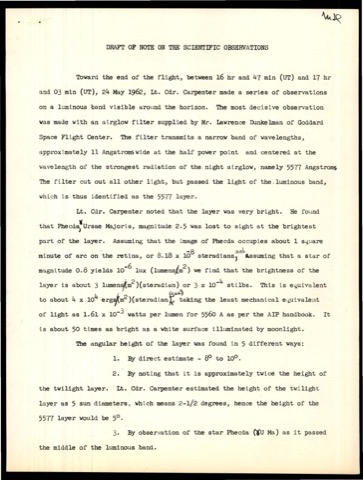
Image from page 57 of NASA-UAP-D015, as released by war.gov
Image from page 57 of the PDF. Open the scan to see the whole page.

Cite this page

National Aeronautics and Space Administration. "Astronaut Scientific Debriefings, 1962-1963" (NASA-UAP-D015). PURSUE Release 03, U.S. Department of War, June 12, 2026. https://www.war.gov/medialink/ufo/061226/release_03/documents/NASA-UAP-D015_Astronaut-Scientific-Debriefings_1962-1963.pdf. Declassified UAP, page 57, https://declassifieduap.org/r/nasa-uap-d015-astronaut-scientific-debriefings-1962-1963/p/57. Accessed November 28, 2026.

This address shows page 57 on its own; /r/nasa-uap-d015-astronaut-scientific-debriefings-1962-1963?page=57 opens the same page in the full reader. Both stay. How to cite.