NASA-UAP-D015

Astronaut Scientific Debriefings, 1962-1963, page 49

One page of a U.S. government record released under PURSUE, shown on its own with its text. The record page has the whole document, its catalog details and the scan.

Page
49 of 216
Agency
NASA
Released
Release 03, June 12, 2026

Text of page 49

LOS ALAMOS SCIENTIFIC LABORATORY UNIVERSITY OF CALIFORNIA LOS ALAMOS. NEW MEXICO TO: Dr. Jocelyn Gill - 9 DATE: July 13, 1962 "pass through" the atmosphere, especially the absorbing layer (perhaps such sequences already exist). At the expected orbital height, I estimate a 7 km thick layer would subtend ~ 1/2 degree and a given light source would "pass through" it in eight seconds. Attempts to derive a density distribution would require a fair number of points in the "1-1/2 or 2 degrees" (divide by 3 3) so a frame interval near one per second seems desirable. If operated continuously thru the night passage approximately 100 feet of 16 mm film would be required per passage. As a crude attempt at spectroscopy, color filters could be used on some of the sequences, without too serious light loss. For example, a Corning No. 5030 or No. 5543 filter would limit exposure to the wavelength range of maximum absorption by NOz (light loss may be considerable) and a Corning No. 3480 filter would limit exposure to the wavelength range where o absorption is negligible. Relatively broad band interference filters would be useable on the brighter stars and planets. Direct visual observation through such filters would also be useful, especially if photography is impractical and the astronaut tries to reproduce any attenuation noted by neutral density filters in combination with the same filters and stars used in space. Photometric observations of some of the "intense" airglows mentioned by various authors would also be very instructive. The increased intensity due to external tangential viewing would help a great deal, and precise height de- terminations could be made • It may be useful to ask Glenn and Carpenter to reproduce the dimming (as well as memory allows) by narrow strips of neutral density filters against the star

Machine-read (OCR) from the scan by this archive; it can contain errors. The scan is the record.
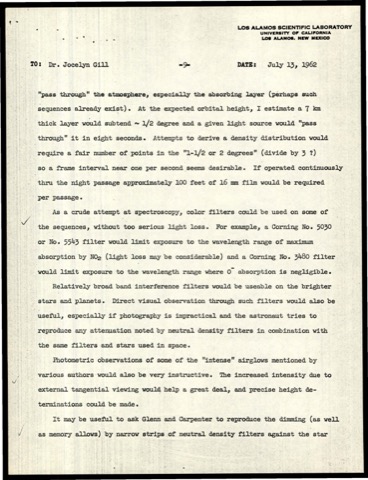
Image from page 49 of NASA-UAP-D015, as released by war.gov
Image from page 49 of the PDF. Open the scan to see the whole page.

Cite this page

National Aeronautics and Space Administration. "Astronaut Scientific Debriefings, 1962-1963" (NASA-UAP-D015). PURSUE Release 03, U.S. Department of War, June 12, 2026. https://www.war.gov/medialink/ufo/061226/release_03/documents/NASA-UAP-D015_Astronaut-Scientific-Debriefings_1962-1963.pdf. Declassified UAP, page 49, https://declassifieduap.org/r/nasa-uap-d015-astronaut-scientific-debriefings-1962-1963/p/49. Accessed November 28, 2026.

This address shows page 49 on its own; /r/nasa-uap-d015-astronaut-scientific-debriefings-1962-1963?page=49 opens the same page in the full reader. Both stay. How to cite.