NASA-UAP-D006
Apollo 17 Technical Crew Debriefing, 1973
- Agency
- NASA
- Format
- Document, 2 pages
- Incident date
- 1973
- Place
- Not given
- Released
- Release 01, May 8, 2026
- Source
- war.gov
- Topics
- Spaceflight, Debriefings & transcripts
Description from war.gov
Page 1
264 p CUNPIDERITAL MSC-07631 NASA NATIONAL AERONAUTICS AND SPACE ADMINISTRATION APOLLO 17 TECHNICAL CREW DEBRIEFING JANUARY 4, 1973 PREPARED BY TRAINING OFFICE CREW TRAINING AND SIMULATION DIVISION This document will automatically become declassified 90 days from the published date. NOTICE: This document may be exempt from public disclosure under the Freedom of Infor- mation Act (5 U.S.C. 552). Requests for its release to persons outside the U.S. Govern- ment should be handled under the provisions of NASA Policy Directive 1382.2. MANNED SPACECRAFT CENTER HOUSTON.TEXAS PGM SUBJECT INDEXING BATA DATE 14 73 M. • 07621 SIGNATOR LOC DECLASSIFIED B.O. 13526, Sec 3.3(a) NASA Declassification Guide Date of Guide: (M) 05 (Y) 2026 Reviewer: r3 Date 56/2026Page 2
24-4 EVANS ( CONT ' D) CERNAN EVANS SCHMITT •CONADENT after the brightness of the fireball decreased, I could look back up through the rendezvous window and see what to me was kind of like a tunnel with a bright spot in the middle of the tunnel. Way down the tunnel, way back behind, I could see the fireball. The only unusual sighting I can recall during landing or recovery is when the CMP looked out the window and saw the superstructure of an aircraft carrier and said, "Oh, we've got a tin can with us." Well, it was kind of foggy on the windows. Transearth we had only a small crescent of an Earth and it was not feasible to do any extensive weather observations. had light flashes just about continuously during the whole flight when we were dark adapted. I had one which I thought was a flash on the lunar surface. That one period of time when we had the blindfolds on for the ALFMED experiment there were just no visible flashes, although that evening, that night, before I went to sleep I noticed that I was seeing the light flashes again. So, it just seemed to be that one interval either side of it where the light flash was not visible to myself or to the other two crewmen.The text is machine-read (OCR) from the scan and can contain errors. The scan is the record.
Machine summary
Written by Claude Sonnet 4.6 (Anthropic) on May 22, 2026, from the record's text and war.gov's description. It is not part of the record and can contain errors; check it against the document.
This document is an excerpt from the Apollo 17 Technical Crew Debriefing, dated January 4, 1973, prepared by NASA's Manned Spacecraft Center in Houston. The debriefing involves the Apollo 17 crew, including Lunar Module Pilot Harrison Schmitt, Command Module Pilot Ronald Evans, and Commander Eugene Cernan. Schmitt reported experiencing near-continuous light flashes throughout the mission when dark-adapted, including one flash he believed originated on the lunar surface. The document was originally marked Confidential and has been declassified under Executive Order 13526.
The light flashes Schmitt describes are consistent with a well-documented phenomenon in spaceflight: cosmic ray interactions with the retina or visual cortex, studied during Apollo through the ALFMED experiment. Schmitt's observation that flashes ceased while wearing ALFMED blindfolds — then resumed afterward — is a data point relevant to that experiment's findings. No information appears redacted in this excerpt. The document is notable in a UAP release context primarily because light flashes observed in space have occasionally been mischaracterized; the debriefing provides the crew's own matter-of-fact technical accounting.
Most frequent words
Select one to highlight it in the text above.
Related records
Similar records 8
Closest matches by the text of the documents.
-
 NASA-UAP-D029 Apollo 17 Crew Medical Debriefing (Continued), 1972
12/21/72
-
 NASA-UAP-D004 Apollo 11 Technical Crew Debriefing, 1969
1969
-
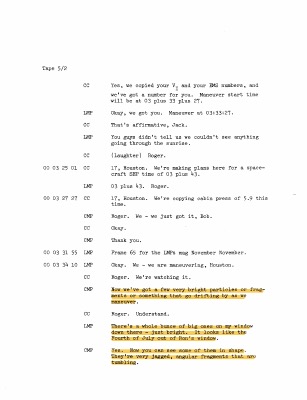 NASA-UAP-D002 Apollo 17 Transcript, 1972
1972
-
 NASA-UAP-D009 Apollo 17 Audio Excerpt, December 7, 1972
12/7/72
-
 NASA-UAP-D028 Apollo 17 Crew Medical Debriefing, 1972
12/21/72
-
 NASA-UAP-D005 Apollo 17 Crew Debriefing for Science, 1973
1973
-
 NASA-UAP-D001 Apollo 12 Transcript, 1969
1969
-
 NASA-UAP-D027 Apollo 14 Debriefing (Continued), 1971
2/18/71