Text of page 2
AF FORM 112—PART II
APPROVED 1 JUNE 1948
FROM (Agency)
DI FEAF ATILO
sofile tiat
GONE
TENTERE
(CLASSIFICATION)
AIR INTELLIGENCE INFORMATION REPORT
REPORT NO.
IR-12-57
2
4
PAGE
OF
RAGES
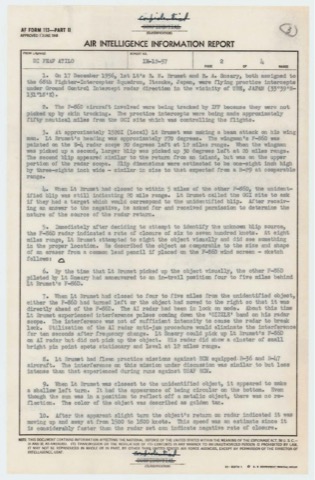
On 17 December 1956, Ist Lt's R. N. Brumet and R. A. Sneary, both assigned to
the 68th Fighter-Interceptor Squadron, Itazuke, Japan, were flying practice intercepts
under Ground Control Intercept radar direction in the vicinity of UBE, JAPAN (33°39'N-
131°1815 •
The F-S6D aircraft involved were being tracked by IFF because they were not
picked up by skin tracking•
The practice intercepts were being made approximately
fifty nautical miles from the GCI site which was controlling the flights.
At approximately 1520I (Local) It Brumet was making a beam attack on his wing
painted on the E-4 radar scope 20 degrees left at 12 miles range.
was picked up a second, larger blip was picked up 30 degrees left at 20 miles range.
The second blip appeared similar to the return fron an island, but was on the upper
by three-eights inch wide - similar in size to that expected fron a B-29 at comparable
range.
4. When It Brumet had closed to within 5 miles of the other F-S6D, the unident-
ified blip was still indicating 20 mile range. Lt Frumet called the CCI site to ask
if they had a target which would correspond to the unidentified blip. After receiv-
ing an answer to the negative, he asked for and received permission to determine the
Immediately after deciding to attempt to identify the unknown blip source,
the F-S6D radar indicated a rate of closure of six to seven hundred knots.
At eight
miles range, It Brumet attempted to sight the object visually and
did see sonething
in the proper location.
He described the object as comparable to the size and shape
of an eraser from a common lead pencil if placed on the F-S6D wind screen - sketch
follows:
5. By the time that Lt Brumet picked up the object visually, the other F-86D
piloted by Lt Sneary had maneuvered to an in-trail position four to five miles behind
When It Brumet had closed to four to five miles from the unidentified object,
the F-86D had turned left or the object had moved to the right so that it was
directly ahead of the F-86D. The AI radar had been in lock on mode.
About this time
It Brunet experienced interference pulses coming down the 'GIZZLE' band on his radar
The interference was not of sufficient intensity to cause the radar to break
Utilization of the AI radar anti-jam procedure would eliminate the interference
for ten seconds after frequency change.
It Sneary could pick up It Brumet's F-86D
on AI radar but did not pick up the object.
His radar did show a cluster of small
bright pin point spots stationary and level at 12 miles range.
It Brunet had flown practice missions against ECM equipped. B-36 and B-47
aircraft.
The interference on this mission under discussion was similar to but less
intense than that experienced during runs against USAF ECM.
When It Brumet was closest to the unidentified object, it appeared to make
a shallow left turn.
It had the appearance of being circular on the bottom.
though the sun was in a position to reflect off a metalic object, there was no re-
flection. The color of the object was described as golden tan.
10. After the apparent slight turn the object's return on radar indicated it was
moving up and away at from 1500 to 1800 knots.
This speed was an estimate since it
is considerably faster than the radar set can indicate negative rate of closure.
NOTE: THIS DOCUMENT CONTAINS INFORMATION AFFECTING THE NATIONAL DEFENSE OF THE UNITED STATES WITHIN THE MEANING OF THE ESPIONAGE ACT, 50 U.S. C.-
31 AND 32, AS AMENDED. ITS TRANSMISSION OR THE REVELATION OF ITS CONTENTS IN ANY MANNER TO AN UNAUTHORIZED PERSON IS PROHIBITED BY LAW.
T MAY NOT BE REPRODUCED IN WHOLE OR IN PART, BY OTHER THAN UNITED STATES AIR FORCE AGENCIES, EXCEPT BY PERMISSION OF THE DIRECTOR O
INTELLIGENCE, USAF.
enfedet
CONPIDENETAL
(CLASSIFICATION)
16- 66670-1
*
-U. 8. GOVERNKENT PRINTING EPPICK