DOW-UAP-D175

BAASS Self-Assessment of UAP Analysis Capabilities, November 2010, page 86

One page of a U.S. government record released under PURSUE, shown on its own with its text. The record page has the whole document, its catalog details and the scan.

Page
86 of 141
Agency
Department of War
Released
Release 07, October 23, 2026

Text of page 86

The amount of power that is reflected back to the radar depends largely on a quantity called the radar cross section (RCS). RCS (o) is technically an area and typically expressed in square meters (m') and depends on the following three factors: Geometric cross section: The area of the object presented to the antenna or projected area is known as the geometric cross the target (Pintercepted) according to the following equation: Pintercepted = APincident Reflectivity: The reflectivity is the fraction of the intercepted power that is reflected by the target, regardless of direction. An object doesn't always reflect equally from all directions as some parts are flat or curved producing varying radar reflection and some of the power is absorbed by the object. Objects that have radar Absorbent Materials (RAM) and radar Absorbent Structures (RAS) are the target (scatter) to the power intercepted by the target (Pintercepted). Pscatter Reflectivity = APintercepted Directivity: The directivity is related to reflectivity but refers to the power scattered back in the direction of the receiving antenna. The power that is reflected toward the antenna is called the backscattered power (backscatter). Directivity is the ratio of the power that is backscattered in the direction of the antenna to the power that would have been scattered in that direction if the scattering were in fact uniform in all directions. Isotropic power (Pistropic) is the power scattered in a perfect sphere over a unit solid angle of that sphere. Pbackscatter Directivity = - Pisotropic Pbackscatter 47 scatter The reflected power will be much greater or much smaller than the isotropic power depending on how the target is oriented to the transmitting antenna. The directivity, therefore, will be much greater than 1 when the target returns a strong backscatter in the direction of the receiving antenna and much less than 1 when the backscatter is small. These three factors can be combined to determine the complete RCS (o) for a target. Summary Report on BAASS UAP Analysis Capabilities November 23, 2010 Page 85

Machine-read (OCR) from the scan by this archive; it can contain errors. The scan is the record.
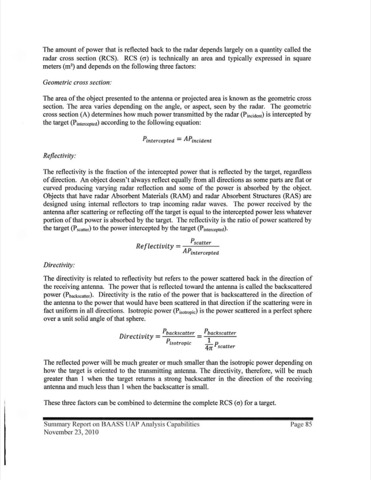
Image from page 86 of DOW-UAP-D175, as released by war.gov
Image from page 86 of the PDF. Open the scan to see the whole page.

Cite this page

U.S. Department of War. "BAASS Self-Assessment of UAP Analysis Capabilities, November 2010" (DOW-UAP-D175). PURSUE Release 07, U.S. Department of War, October 23, 2026. https://www.war.gov/medialink/ufo/release-07/documents/DOW-UAP-D175-BAASS_Self-Assessment_of_UAP_Analysis_Capabilities_November_2010.pdf. Declassified UAP, page 86, https://declassifieduap.org/r/dow-uap-d175-baass-self-assessment-of-uap-analysis-capabilities-november-2010/p/86. Accessed November 28, 2026.

This address shows page 86 on its own; /r/dow-uap-d175-baass-self-assessment-of-uap-analysis-capabilities-november-2010?page=86 opens the same page in the full reader. Both stay. How to cite.