DOW-UAP-D175

BAASS Self-Assessment of UAP Analysis Capabilities, November 2010, page 84

One page of a U.S. government record released under PURSUE, shown on its own with its text. The record page has the whole document, its catalog details and the scan.

Page
84 of 141
Agency
Department of War
Released
Release 07, October 23, 2026

Text of page 84

4.2.3 Radar Cross Section Analysis of a Spherical UFO Many UAP have been reported across the globe. Pilots have reported seeing these craft in the air, but when asked for confirmation of other aireraft in the area, air traffic control reports nothing on radar. Only a tiny fraction of energy is bounced back to the receiving antenna, even though many megawatts of power may be transmitted in a single pulse. The amount of power returned from a target to the transmitting radar depends on four major factors: 1. The power transmitted in the direction of the target. 2. The amount of power that impacts the target and is reflected back in the direction of the antenna. This is directly relational to the range between the antenna and target and the target's RCS. 3. The amount of reflected power that is received by the antenna. 4. The length of time in which the antenna is pointed at the target. Power of Waves Radiated Toward Target Fraction of Backscatter Captured by Antenna 9 10 ms Fraction of Intercepted Power Scattered Toward Radar Time on Target Figure 55. Factors that Determine the Energy Returned by a Target (Aerospaceweb.org, 2010) Power flux is used to describe the relationship between these variables. The further the radar wave travels, the greater the power transmitted decrease because it is spread over a larger area. The inverse square law of the range R or 1/R' governs the area over which the power is spread from the transmitting radar. The power flux or power density of the transmitted radar wave at the range of the target has a special name called the incident power density (Pincident). Summary Report on BAASS UAP Analysis Capabilities November 23, 2010 Page 83

Machine-read (OCR) from the scan by this archive; it can contain errors. The scan is the record.
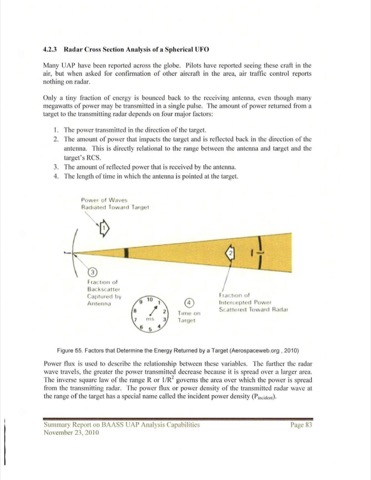
Image from page 84 of DOW-UAP-D175, as released by war.gov
Image from page 84 of the PDF. Open the scan to see the whole page.

Cite this page

U.S. Department of War. "BAASS Self-Assessment of UAP Analysis Capabilities, November 2010" (DOW-UAP-D175). PURSUE Release 07, U.S. Department of War, October 23, 2026. https://www.war.gov/medialink/ufo/release-07/documents/DOW-UAP-D175-BAASS_Self-Assessment_of_UAP_Analysis_Capabilities_November_2010.pdf. Declassified UAP, page 84, https://declassifieduap.org/r/dow-uap-d175-baass-self-assessment-of-uap-analysis-capabilities-november-2010/p/84. Accessed November 28, 2026.

This address shows page 84 on its own; /r/dow-uap-d175-baass-self-assessment-of-uap-analysis-capabilities-november-2010?page=84 opens the same page in the full reader. Both stay. How to cite.