DOW-UAP-D175

BAASS Self-Assessment of UAP Analysis Capabilities, November 2010, page 47

One page of a U.S. government record released under PURSUE, shown on its own with its text. The record page has the whole document, its catalog details and the scan.

Page
47 of 141
Agency
Department of War
Released
Release 07, October 23, 2026

Text of page 47

2.176e+000 2.040e+000 1.904e+000 1.76Be+000 1.6320+000 1.49Бe+000 1:3000+000 1. 224e+000 1.088e+000 9.518e-001 8.159e-001 6.799e-001 5.439e-001 4.079e-001 2. 720e 001 1.360e-001 1,000c-015 Figure 25. Cylinder Mach Number at 1/6 Scale, Air Temperature 223K and 1500 mph with Supersonic Inlet and Supersonic Outlet 4.1.4 Summary and Conclusions of Compressible Numerical Analyses In the field of UAP studies, it is believed this preliminary analysis of the "Tic Tac" incident is the first of its kind to utilize a multi-industry standard FEA code to perform computational studies. The cases used are provided as a basic demonstration of the CFX fluid flow module and illustrate some of its capabilities, as well as a sample of some visualization tools. 4.1.4.1 "Tic Tac" Geometry For the contour plots of pressure, temperature from 100 mph up to 500 mph, gradual increases in values are observed, with the most significant value change at the front of the object. The Mach number values increase at the front sides of the object. Disturbance of air flow is witnessed in the pressure and Mach contour profiles around the body. Nearing the speed of sound at 700 mph, contours for pressure and Mach number started to show a more pronounced shock as would be expected. Temperature values also showed a higher increase at the front nose due to higher flow and air resistance over the body. Velocities higher than 700 mph showed a drastic difference in values compared to those at 100 mph with pressure differences in orders of magnitude. At 1,100 mph, the temperature rises not only at the attack nose, but started to even increase on the sides and in the wakes of air flow. Detached shock waves were witnessed in the pressure and Mach contours starting at 700 mph all the way up to 1,500 mph. Summary Report on BAASS UAP Analysis Capabilities November 23, 2010 Page 46

Machine-read (OCR) from the scan by this archive; it can contain errors. The scan is the record.
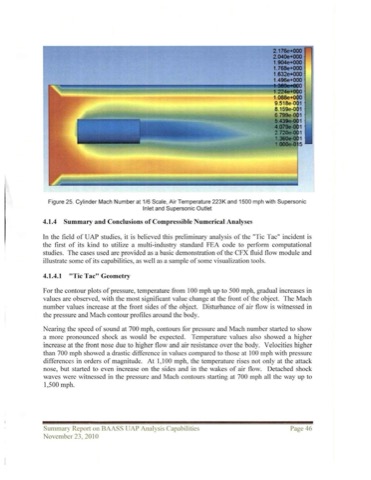
Image from page 47 of DOW-UAP-D175, as released by war.gov
Image from page 47 of the PDF. Open the scan to see the whole page.

Cite this page

U.S. Department of War. "BAASS Self-Assessment of UAP Analysis Capabilities, November 2010" (DOW-UAP-D175). PURSUE Release 07, U.S. Department of War, October 23, 2026. https://www.war.gov/medialink/ufo/release-07/documents/DOW-UAP-D175-BAASS_Self-Assessment_of_UAP_Analysis_Capabilities_November_2010.pdf. Declassified UAP, page 47, https://declassifieduap.org/r/dow-uap-d175-baass-self-assessment-of-uap-analysis-capabilities-november-2010/p/47. Accessed November 28, 2026.

This address shows page 47 on its own; /r/dow-uap-d175-baass-self-assessment-of-uap-analysis-capabilities-november-2010?page=47 opens the same page in the full reader. Both stay. How to cite.