DOW-UAP-D175

BAASS Self-Assessment of UAP Analysis Capabilities, November 2010, page 33

One page of a U.S. government record released under PURSUE, shown on its own with its text. The record page has the whole document, its catalog details and the scan.

Page
33 of 141
Agency
Department of War
Released
Release 07, October 23, 2026

Text of page 33

The AAV possibly demonstrated a highly advanced capability to operate undersea completely undetectable by our most advanced sensors. The so called "Tic Tac" incident has many physics and engineering aspects that may be studied with regards to understanding the performance capabilities and propulsion mechanisms of the craft. Since there was little hard data, most analyses of the incident had to be made using either parametric studies or assumptions based on eye witness testimony. 4.1.1 Analytical Solutions of Velocities and Accelerations Associated with "Tic Tac" Performance An initial starting point consisted of using basic physics formulas for the calculation of velocities and accelerations based on the distances the object traveled and the duration time t of the Since no exact duration was known, as the radar operator noted that it occurred in a matter of "seconds," a parametric range from 0.5 seconds to 10 seconds was studied (assuming instantaneous velocities and accelerations). dv a =- dt Flight is classified in six categories as shown in the table below. Table 1. Mach Regimes Regime Mach Number Subsonic Transonic Sonic Supersonic Hypersonic High-hypersonic < 1.0 0.8 - 1.2 1.0 1.0 - 5.0 5.0 - 10.0 10.0 - 25.0 Re-entry Speeds > 25.0 Due to the lack of data, only the instantaneous velocity of the craft v and the instantaneous acceleration a, were computable. For the velocity and deceleration witnessed, a negative sign is implied to represent the direction component of the vector. Assumptions: 1. Elevation of 60,000 ft to Sea Level - It was reported by radar observation the object descended from approximately 60,000 ft to sea level in a matter of seconds. 2. Matter of Seconds - A range of 0.5 seconds to 10 seconds was used for a parametric study. 4.1.2 Summary of Analytical Velocity and Acceleration Solutions Table 2 provides the computed values of instantaneous velocities and decelerations in ft/s and mph and ft/sec and g respectively for each chosen At. Figure 11 through Figure 14 show Summary Report on BAASS UAP Analysis Capabilities Page 32 November 23, 2010

Machine-read (OCR) from the scan by this archive; it can contain errors. The scan is the record.
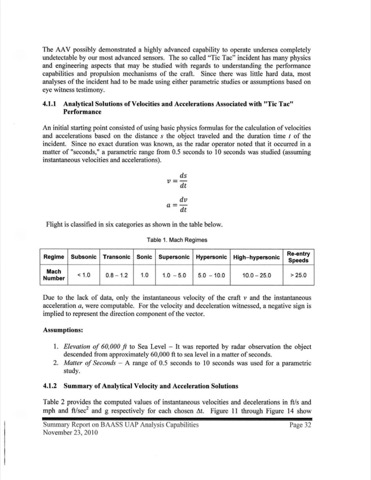
Image from page 33 of DOW-UAP-D175, as released by war.gov
Image from page 33 of the PDF. Open the scan to see the whole page.

Cite this page

U.S. Department of War. "BAASS Self-Assessment of UAP Analysis Capabilities, November 2010" (DOW-UAP-D175). PURSUE Release 07, U.S. Department of War, October 23, 2026. https://www.war.gov/medialink/ufo/release-07/documents/DOW-UAP-D175-BAASS_Self-Assessment_of_UAP_Analysis_Capabilities_November_2010.pdf. Declassified UAP, page 33, https://declassifieduap.org/r/dow-uap-d175-baass-self-assessment-of-uap-analysis-capabilities-november-2010/p/33. Accessed November 28, 2026.

This address shows page 33 on its own; /r/dow-uap-d175-baass-self-assessment-of-uap-analysis-capabilities-november-2010?page=33 opens the same page in the full reader. Both stay. How to cite.