DOW-UAP-D175

BAASS Self-Assessment of UAP Analysis Capabilities, November 2010, page 21

One page of a U.S. government record released under PURSUE, shown on its own with its text. The record page has the whole document, its catalog details and the scan.

Page
21 of 141
Agency
Department of War
Released
Release 07, October 23, 2026

Text of page 21

The BAASS Data Warehouse is an electronic repository for historical, ongoing, and future UAP reporting and investigations. The Data Warehouse is designed to facilitate sophisticated analyses and data mining to improve our understanding of the extent, structure, and frequency of UAP, as well as their potential correlation to known physical, environmental, biological, or socio-political factors. 2.3.4.1 CAPELLA Format AAP Person 5, AAP The CAPELLA database format is based upon the "Six Layer Model for Anomalous Person 58 Phenomena" developed by AAP Person 5 Jand AAP Person 58 This six layer model encapsulates all of the potential characteristics of UAP events that can be studied. The six layers are: 1. The Physical Layer - those physical characteristics associated with a UAP event 2. The Anti-Physical Layer - the patterns that conflict with those predicted in modern physics 3. The Psychological Layer - the psychological impacts to the witnesses) and the social conditions that surround them 4. The Physiological Layer - the effects perceived by humans 5. The Psychic Layer - the effects commonly found in parapsychology literature 6. The Cultural Layer - the primary and secondary effects upon society. Additionally, the CAPELLA format captures administrative details associated with the UAP event, such as witness information, location, date, time, duration, etc. 2.3.4.2 Data Warehouse Upgrade BAASS is undergoing a database upgrade project to further enhance data security and integrity, and increase processing power for greater analytical capability. The CAPELLA framework and methodologies will be preserved in the upgraded system. This upgrade will increase efficiency and effectiveness, and will allow databases to be analyzed individually or collectively. 2.3.4.3 Statistical Analysis BAASS has completed a first-level, yet comprehensive statistical analyses for three of the and the Utah Ranch Database. identify potential times and improve the means of future detection methods. Summary Report on BAASS UAP Analysis Capabilities November 23, 2010 Page 20

Machine-read (OCR) from the scan by this archive; it can contain errors. The scan is the record.
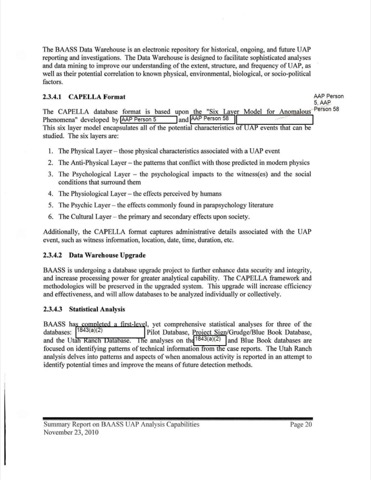
Image from page 21 of DOW-UAP-D175, as released by war.gov
Image from page 21 of the PDF. Open the scan to see the whole page.

Cite this page

U.S. Department of War. "BAASS Self-Assessment of UAP Analysis Capabilities, November 2010" (DOW-UAP-D175). PURSUE Release 07, U.S. Department of War, October 23, 2026. https://www.war.gov/medialink/ufo/release-07/documents/DOW-UAP-D175-BAASS_Self-Assessment_of_UAP_Analysis_Capabilities_November_2010.pdf. Declassified UAP, page 21, https://declassifieduap.org/r/dow-uap-d175-baass-self-assessment-of-uap-analysis-capabilities-november-2010/p/21. Accessed November 28, 2026.

This address shows page 21 on its own; /r/dow-uap-d175-baass-self-assessment-of-uap-analysis-capabilities-november-2010?page=21 opens the same page in the full reader. Both stay. How to cite.