DOW-UAP-D167

Project Capella, December 2008, page 36

One page of a U.S. government record released under PURSUE, shown on its own with its text. The record page has the whole document, its catalog details and the scan.

Page
36 of 42
Agency
Department of War
Released
Release 07, October 23, 2026

Archive note war.gov's data file spells the location "San Fransisco"; this archive corrects the spelling. See all corrections

Text of page 36

Appendix C Data Structures and Software Platforms in support of Aerial Phenomena Research: Proposed Organization, with examples RAP Person 5 Documatica Research, LLC The implementation of data bases for the purpose of research poses unusual challenges for the software analyst. While an industrial database might consist of millions of items in a rapidly- changing transaction environment, the data elements are well-defined and their characteristics are fixed. For example, a database of parts for a car company will consist of elements where composition, size, weight, price and availability are known at any given time. Furthermore, a team of specialists is in charge of maintaining the database and optimizing it for specific corporate departments whose requirements have been taken into account at the time of design. The situation is very different in research: Not all the questions to be posed can be defined at the beginning of design; new elements, or novel ways of characterizing them, may appear in the course of the project; there may be different user communities to be served; and even the, nature of the phenomenon under study may be in question. The problem of unexplained aerial phenomena is of particular complexity, because the database must accommodate not only initial hypotheses or mind frames of the designers, but those of future groups of users with unpredictable requirements. Some of the users may be strong believers in a particular interpretation of the data, or they may look for certain patterns, while researchers with opposing views (or skeptics) will need to access the same data to creatively challenge their colleagues' conclusions. The design must serve all these needs. In prior work the author and his colleagues have defined a general classification system for reports based on the observed behavior of the phenomenon. This three-digit system was adopted years ago by several catalogues, notably by NIDS in the 1990s, by UFOCAT (a catalogue of the CUFOS organization) and by 1843(a)(2) in France in support of his AAP Appendix C page 1 Person 5

Machine-read (OCR) from the scan by this archive; it can contain errors. The scan is the record.
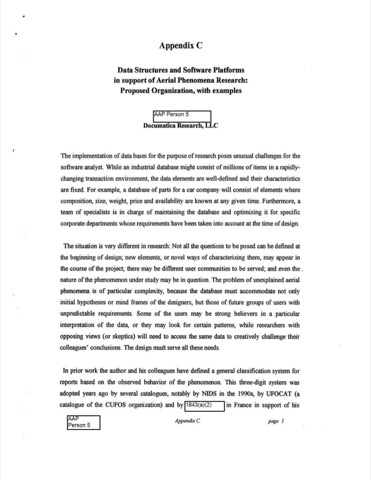
Image from page 36 of DOW-UAP-D167, as released by war.gov
Image from page 36 of the PDF. Open the scan to see the whole page.

Cite this page

U.S. Department of War. "Project Capella, December 2008" (DOW-UAP-D167). PURSUE Release 07, U.S. Department of War, October 23, 2026. https://www.war.gov/medialink/ufo/release-07/documents/DOW-UAP-D167-Project_Capella-December-2008.pdf. Declassified UAP, page 36, https://declassifieduap.org/r/dow-uap-d167-project-capella-december-2008/p/36. Accessed November 28, 2026.

This address shows page 36 on its own; /r/dow-uap-d167-project-capella-december-2008?page=36 opens the same page in the full reader. Both stay. How to cite.