DOW-UAP-D153

AAWSAP DIRD, Quantum Tomography of Negative Energy States in the Vacuum, January 2011, page 41

One page of a U.S. government record released under PURSUE, shown on its own with its text. The record page has the whole document, its catalog details and the scan.

Page
41 of 51
Agency
Department of War
Released
Release 06, September 18, 2026

Text of page 41

UNCLASSIFIED//FOR OI AL Ust ontY # dip-int = ex' @Ê, (x, f) • g(t) where e is the electron charge and g(t) is a smooth test (or smearing) function that is equal to 1 during the measurement and smoothly vanishing elsewhere. Using first-order time-dependent perturbation theory, Marecki [5, 6] derived the probability of excitation: Pexe (8,x) = | dids g(7)g(s)G* (7 - 5) Ê,(t, 7) Ê, (t,s) (14) where G"(T-s) = fda(0|x'(7) |4)(9|x°(s)|0) is the electronic two-point function, + and s are dummy time and integration variables, and {disg(7)g(s) is the temporal sensitivity in the measurement process. The balanced homodyne detector consists of an arrangement of two photodiodes, whose outputs are subtracted, and illuminated with an auxiliary coherent state of the radiation field (i.e., the local oscillator, LO; see Figure 15). Per the discussion in Section IIIB-4, the LO is used as a tool to investigate the properties of a certain state S of the quantum radiation field under study, and so on a BHD the state S is optically mixed with the coherent LO state (see References [5] or [6] for further details). The quantum field S de-balances the detector (stochastic process of measurement). The expectation value of the observable corresponding to the electronic charge collected at the point P in Figure 15 (i.e., the BHD current) is the difference of excitation probabilities of the two photodiodes [5, 6]: (J)s = Poxe (g,*) - Pox (8, 1), where positions i and y correspond to the positions & and y in Figure 15. Further calculations and other theoretical considerations lead to the following final result for (J)s [5, 6]: (1)s = 0, • Elo • (E, (x,,) + E, (v, ta)s where der depends on the electronic structure of the PIN semiconductor in the photodiode, E' Lo is the electric field of the LO (corresponding to F in Figure 15), to is the LO phase that can easily be varied in experiments, and all field operators Ê(i, t) are restricted to the frequency a of the LO. 37 UNCLASSIFIED// FOR OFFICIAL USE ONLY

Machine-read (OCR) from the scan by this archive; it can contain errors. The scan is the record.
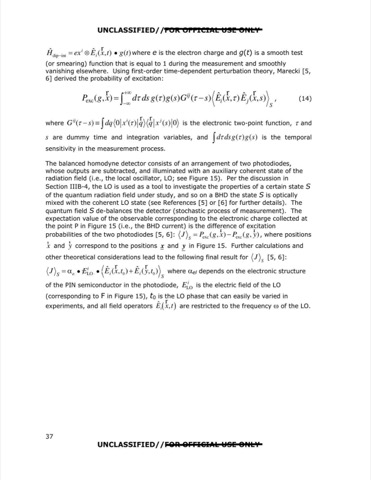
Image from page 41 of DOW-UAP-D153, as released by war.gov
Image from page 41 of the PDF. Open the scan to see the whole page.

Cite this page

U.S. Department of War. "AAWSAP DIRD, Quantum Tomography of Negative Energy States in the Vacuum, January 2011" (DOW-UAP-D153). PURSUE Release 06, U.S. Department of War, September 18, 2026. https://www.war.gov/medialink/ufo/sept-18/release-06/assets/DOW-UAP-D153_AAWSAP-DIRD-Quantum-Tomography-of-Negative-Energy-States-in-the-Vacuum-January-11-2011.pdf. Declassified UAP, page 41, https://declassifieduap.org/r/dow-uap-d153-aawsap-dird-quantum-tomography-of-negative-energy-states-in-the-vacuum-january-2011/p/41. Accessed November 28, 2026.

This address shows page 41 on its own; /r/dow-uap-d153-aawsap-dird-quantum-tomography-of-negative-energy-states-in-the-vacuum-january-2011?page=41 opens the same page in the full reader. Both stay. How to cite.