Text of page 38
UNCLASSIFIED/ /EOR OFFI
AL USE ONLY-
drawback of this approach is that it reveals information about the quantum state only
within the sideband chosen for the measurement. Therefore, the method is
incompatible with other techniques for characterizing a quantum state for which such
precise selection of spectral modes is impossible. Time-domain BHD resolves this
limitation. Hansen et al. [4] describe their experimental time-domain BHD device.
They developed a pulsed BHD for precise measurement of the electric field quadratures
of pulsed optical quantum states. A high level of common mode suppression (> 85 dB)
and low electronic noise (730 electrons per pulse) in their device provides a signal-to-
noise ratio of 14 dB for measurement of the quantum noise of individual pulses. Their
device achieved a signal-to-noise ratio of 14 dB at a pulse repetition rate of up to 1 MHz,
enabling high-accuracy quantum measurements to be carried out in a short time. They
performed a quantum tomography of the coherent state as a test for their device, and
the Wigner function and density matrix were reconstructed with 99.5% fidelity while
their detector exhibited 91% quantum efficiency. Their detection system can also be
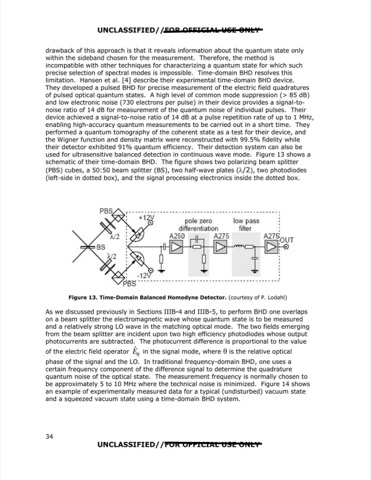
used for ultrasensitive balanced detection in continuous wave mode. Figure 13 shows a
schematic of their time-domain BHD. The figure shows two polarizing beam splitter
(PBS) cubes, a 50:50 beam splitter (BS), two half-wave plates (2/2), two photodiodes
(left-side in dotted box), and the signal processing electronics inside the dotted box.
PBS
pole zero
differentiation
A250
A275
low pass
filter
A275 OUT
BS
PBS
Figure 13. Time-Domain Balanced Homodyne Detector. (courtesy of P. Lodahl)
As we discussed previously in Sections IIIB-4 and IIIB-5, to perform BHD one overlaps
on a beam splitter the electromagnetic wave whose quantum state is to be measured
and a relatively strong LO wave in the matching optical mode. The two fields emerging
from the beam splitter are incident upon two high efficiency photodiodes whose output
photocurrents are subtracted. The photocurrent difference is proportional to the value
of the electric field operator Eo
in the signal mode, where 0 is the relative optical
phase of the signal and the LO. In traditional frequency-domain BHD, one uses a
certain frequency component of the difference signal to determine the quadrature
quantum noise of the optical state. The measurement frequency is normally chosen to
be approximately 5 to 10 MHz where the technical noise is minimized. Figure 14 shows
an example of experimentally measured data for a typical (undisturbed) vacuum state
and a squeezed vacuum state using a time-domain BHD system.
34
UNCLASSIFIED//FOR OFFICIAL USE ONLY