DOW-UAP-D153

AAWSAP DIRD, Quantum Tomography of Negative Energy States in the Vacuum, January 2011, page 20

One page of a U.S. government record released under PURSUE, shown on its own with its text. The record page has the whole document, its catalog details and the scan.

Page
20 of 51
Agency
Department of War
Released
Release 06, September 18, 2026

Text of page 20

UNCLASSIFIED//EAR OFFICIAL USE ONLY between the strength of the negative energy density/flux and the behavior of the detector. It is curious that Davies and Ottewill did not consider using quantum optical homodyne tomography as a tool to test their hypothesis, because this is already a mature experimental discipline. In what follows we outline the basics of quantum optical homodyne tomography and its application to detecting and measuring negative energy density/flux states in squeezed light and in the Casimir effect. Basic Notions of Quantum Optical Homodyne Tomography Tomography, from the Greek word for slice, is a method to infer the shape of a hidden object from its shadows (or projections) under various angles. Quantum tomography is the application of this idea to quantum mechanics. In optical homodyne tomography, the Wigner function or, more generally, the quantum state plays the role of the hidden object. The observable "quantum shadows" are the quadrature distributions and are measured using homodyne detection. From these distributions the Wigner function is reconstructed. See Figure 3 for an illustration of quantum optical homodyne tomography. The vertical 2-dimensional plane seen in the figure is fictitious and is shown for illustrative purposes only. Figure 3. Illustration of Quantum Optical Homodyne Tomography (courtesy of Ulf Leonhardt). The Wigner function (3-dimensional hill on the right) is reconstructed in quantum phase space (gridded plane formed by quadratures q and p) from its experimentally measured projections (curve in vertical 2-dimensional plane), which represents the scanning process of tomography. The vertical axis is the magnitude of the Wigner (quasiprobability) function. Quantum tomography was developed for the simple reason that a fundamental feature of quantum mechanics prevents us from seeing physical objects in their full quantum complexity. This is due to the intrinsic fuzziness in the quantum nature of energy and matter according to the Heisenberg Uncertainty Principle, which prevents us from simultaneously and precisely measuring the complementary features (e.g., position and momentum or energy and time) comprising quantum states. For this reason we cannot 16 UNCLASSIFIED//FOR OFF: AL USE ONLY

Machine-read (OCR) from the scan by this archive; it can contain errors. The scan is the record.
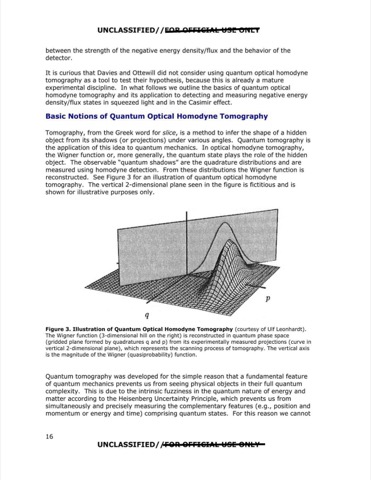
Image from page 20 of DOW-UAP-D153, as released by war.gov
Image from page 20 of the PDF. Open the scan to see the whole page.

Cite this page

U.S. Department of War. "AAWSAP DIRD, Quantum Tomography of Negative Energy States in the Vacuum, January 2011" (DOW-UAP-D153). PURSUE Release 06, U.S. Department of War, September 18, 2026. https://www.war.gov/medialink/ufo/sept-18/release-06/assets/DOW-UAP-D153_AAWSAP-DIRD-Quantum-Tomography-of-Negative-Energy-States-in-the-Vacuum-January-11-2011.pdf. Declassified UAP, page 20, https://declassifieduap.org/r/dow-uap-d153-aawsap-dird-quantum-tomography-of-negative-energy-states-in-the-vacuum-january-2011/p/20. Accessed November 28, 2026.

This address shows page 20 on its own; /r/dow-uap-d153-aawsap-dird-quantum-tomography-of-negative-energy-states-in-the-vacuum-january-2011?page=20 opens the same page in the full reader. Both stay. How to cite.