Text of page 10
UNCLASSIFIED//FOR
AL USE ONL
but depends on the state of u(x,t). This state exists even if literally nothing is in the
mode chosen by the observer. In this case, the light is just in the vacuum state.$
However, this "nothing" can indeed cause significant physical effects as will be
discussed in later sections.
To make all this more precise, we postulate that the electric field strength Ê of the light
field is given by Ê=u (x,t)â+u(x,t)ất and that the amplitude operator â is a bosonic**
annihilation operator that obeys the quantum mechanical commutation relation
â, ât ]=1, where u(x,t) is the complex conjugate of u(x,t) and a
is the adjoint (or
conjugate) of â called the creation operator.** The hat symbol appearing over
quantities denotes that they are quantum operators (or observables). Another key
element of quantum-oscillator physics is the photon number operator in, which
accounts for the number of photons (quantized light particles) in the chosen u(x,t) and
is given by the quantum mechanical counterpart of a classical modulus-squared
amplitude: ^ =â a.
Let us now introduce a pair of operators, q and p, called quadratures. They are
defined as 9=2-12(ấ* +â) and p=i2-'2 (ất -â), which can be inverted to provide the
additional useful definitions â= 2-12(ậ+ip) and * = 2-12 (ậ-ip). In optics a and p
correspond to the in-phase and the out-of-phase component of the electric field
amplitude of u(x,t) (with respect to a reference phase). The bosonic commutation
relation demonstrates that @ and p are canonically conjugate observables, [q,₽] = ih.
The quadratures q and p can be regarded as the position and the momentum of the
quantum electromagnetic oscillator. They do not appear in real space but in the phase
space spanned by the complex vibrational amplitude â of the quantum electromagnetic
oscillator, and they have nothing to do with the position and the momentum of a
photon. However, the canonical commutation relation entitles us to treat â and p as
perfect examples of position- and momentum-like quantities in quantum optics. Finally,
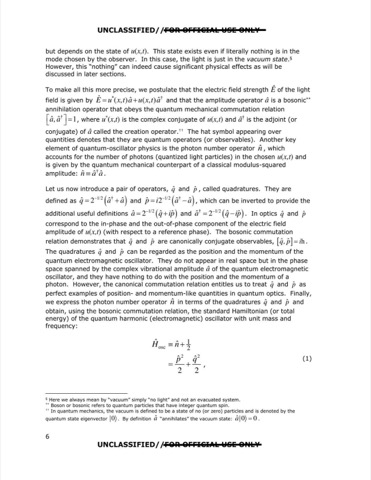
we express the photon number operator i in terms of the quadratures { and p and
obtain, using the bosonic commutation relation, the standard Hamiltonian (or total
energy) of the quantum harmonic (electromagnetic) oscillator with unit mass and
frequency:
(1)
2'
§ Here we always mean by "vacuum" simply "no light" and not an evacuated system.
* Boson or bosonic refers to quantum particles that have integer quantum spin.
** In quantum mechanics, the vacuum is defined to be a state of no (or zero) particles and is denoted by the
quantum state eigenvector |0). By definition ^ "annihilates" the vacuum state: â| 0) = 0 .
6
UNCLASSIFIED//FOR OFFICIAL USE ONLY