DOW-UAP-D152

AAWSAP DIRD, Negative Mass Propulsion, January 2011, page 41

One page of a U.S. government record released under PURSUE, shown on its own with its text. The record page has the whole document, its catalog details and the scan.

Page
41 of 43
Agency
Department of War
Released
Release 06, September 18, 2026

Text of page 41

UNCLASSIFIED//FOR OFFICIAL USE ONLY make a critical assembly) released. For a 10 kiloton fission explosion the shatter radius computed from (110) is ~ 20 m. With a tunnel radius ro ~ 10 m one would have (rs/ro) ~ 2and from (118) that = 2' (Po/Pmax). (121) Putting for the depth of the tunnel (if measured from the surface of the moon) б = R-r, with 28/R= 2' (Po/ Pmax) = 10-2 (122) or that 6 = 10 km. For a depth < 10 km the nuclear explosion with a yield < 10 kiloton would suffice, a yield which is uneconomical. It is for this reason suggested that one uses altogether thermonuclear explosive devices where the cost per yield is much lower. To penetrate and shatter the rocks more efficiently, jet-generating thermonuclear explosive lenses could be used. The thermonuclear detonation wave ignited at one point is there shaped into a jet-producing conical explosion by placing obstacles in the path of the wave. The ignition can be done by a fission explosive, but conceivably also by a powerful laser beam, with the laser beam projected down the tunnel shaft, triggering the thermonuclear explosive positioned at the lower end. With the above-given estimate of ~ 50 Megaton needed to dig the tunnel shaft, the number of thermonuclear explosive devices making use of the detonation wave lens technique could for this reason be quite reasonable, and certainly much less than the number of required fission explosives. After nuclear explosions have crushed the rocks and the heat is removed, the tunnel wall has to be made from some kind of ceramic material, since water with which to make concrete is only sparsely available on the moon. But for the wall to last, its temperature must be kept low. The low heat conductivity of rocks, requiring little cooling, is there of considerable help. For the crushed rocks the heat conduction coefficient should not be very different than for solid rocks. According to eqn (112) the 37 UNCLASSIFIED//FOR OFFICIAL USE @ALY

Machine-read (OCR) from the scan by this archive; it can contain errors. The scan is the record.
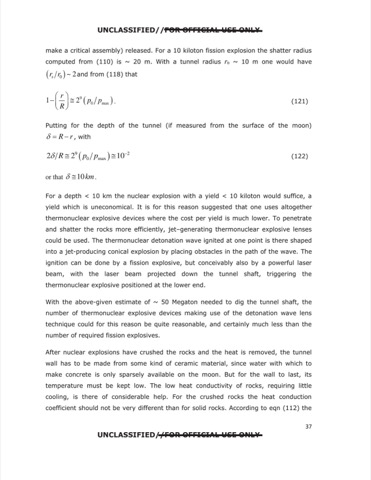
Image from page 41 of DOW-UAP-D152, as released by war.gov
Image from page 41 of the PDF. Open the scan to see the whole page.

Cite this page

U.S. Department of War. "AAWSAP DIRD, Negative Mass Propulsion, January 2011" (DOW-UAP-D152). PURSUE Release 06, U.S. Department of War, September 18, 2026. https://www.war.gov/medialink/ufo/sept-18/release-06/assets/DOW-UAP-D152_AAWSAP-DIRD-Negative-Mass-Propulsion-January-3-2011.pdf. Declassified UAP, page 41, https://declassifieduap.org/r/dow-uap-d152-aawsap-dird-negative-mass-propulsion-january-2011/p/41. Accessed November 28, 2026.

This address shows page 41 on its own; /r/dow-uap-d152-aawsap-dird-negative-mass-propulsion-january-2011?page=41 opens the same page in the full reader. Both stay. How to cite.