DOW-UAP-D151

AAWSAP DIRD, Cognitive Limits on Simultaneous Control of Multiple Unmanned Spacecraft, December 2010, page 7

One page of a U.S. government record released under PURSUE, shown on its own with its text. The record page has the whole document, its catalog details and the scan.

Page
7 of 31
Agency
Department of War
Released
Release 06, September 18, 2026

Text of page 7

UNCLASSIFIED//EOR OFFICIAL USE ONLY audio processing, and this is where multiple resource theory enters: different resources can be considered independent if demands on one resource do not tax the availability of capacity of the other. Performance of a task can be high or low: in general if spare capacity is available, performance is high, and if capacity is limited or exceeded, performance is low. Moreover, task demand enforces a fixed theoretical relationship between mental workload and task performance: this is shown in Figure 1. Relationship between Workload and Task Performance High ** Performance Workload Low D A1 A2 A3 B Task Demand Figure 1. One-dimensional Representation of Changes in Performance as Workload Varies. Task demand increases to the right. In the three A regions, performance remains unchanged: A2 is optimal, where a trained operator exerts minimal effort to maintain a set level of performance. At times of low demand the operator exerts effort to maintain vigilance (A1) until demand is so low, the subject disengages from the task (D). The workload curve is not well defined at very low levels of demand (dotted lines). At the other end, as demand increases, the subject can exert effort to keep up with demand (A3). Additional effort maintains performance until degradation begins (B), and in the overload condition, region C, performance is degraded beyond acceptable levels. While effort is maintained in overload, some low level of performance exists. 2 UNCLASSIFIED//FOR OFFICIAL USE ONLY

Machine-read (OCR) from the scan by this archive; it can contain errors. The scan is the record.
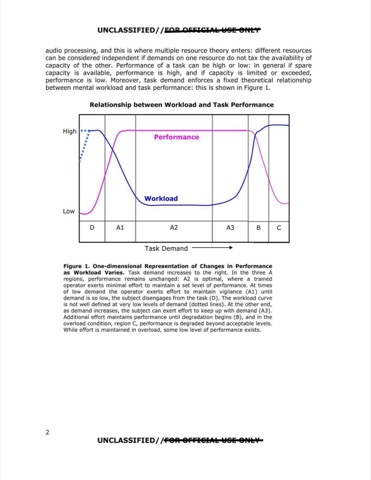
Image from page 7 of DOW-UAP-D151, as released by war.gov
Image from page 7 of the PDF. Open the scan to see the whole page.

Cite this page

U.S. Department of War. "AAWSAP DIRD, Cognitive Limits on Simultaneous Control of Multiple Unmanned Spacecraft, December 2010" (DOW-UAP-D151). PURSUE Release 06, U.S. Department of War, September 18, 2026. https://www.war.gov/medialink/ufo/sept-18/release-06/assets/DOW-UAP-D151_AAWSAP-DIRD-Cognitive-Limits-on-Simultaneous-Control-of-Multiple-Unmanned-Spacecraft-December-15-2010.pdf. Declassified UAP, page 7, https://declassifieduap.org/r/dow-uap-d151-aawsap-dird-cognitive-limits-on-simultaneous-control-of-multiple-unmanned-spacecraft-december-2010/p/7. Accessed November 28, 2026.

This address shows page 7 on its own; /r/dow-uap-d151-aawsap-dird-cognitive-limits-on-simultaneous-control-of-multiple-unmanned-spacecraft-december-2010?page=7 opens the same page in the full reader. Both stay. How to cite.