DOW-UAP-D151

AAWSAP DIRD, Cognitive Limits on Simultaneous Control of Multiple Unmanned Spacecraft, December 2010, page 27

One page of a U.S. government record released under PURSUE, shown on its own with its text. The record page has the whole document, its catalog details and the scan.

Page
27 of 31
Agency
Department of War
Released
Release 06, September 18, 2026

Text of page 27

UNCLASSIFIED//EOR OFFIC AL USE ONLY Chapter 5: Discussion We have insight into the maximum number of tracked objects in a multiple space vehicle piloting experiment: it depends greatly on the complexity of the piloting and mission tasks. Brookings showed that in the ATC task, mild complexity affected performance even for a little as six planes being tracked by professional controllers, whereas these controllers regularly track up to ten. Ruff showed that when there is uncertainty in the augmentation system, a maximum of four craft can be controlled and tasked to complete missions. The number of four is consistent with standard estimates of human working memory being able to handle three to five disparate objects at a time. This implies that disparate, complex interfaces require resources from working memory to prevent loss of the big picture. Augmentation of the human capabilities mainly appears to be helping to maintain a higher number of working memory registers. Whether it is the handwritten blocks for the Are, the store the ATCs, the stored instructions for the Dixon study, or the dual displays of Cummings, the most effective augmentations in the studies above hold information for quick visual retrieval that the brain would otherwise keep in working memory. Any external automation system to assist the operator in making decisions will have an associated error rate. It was also shown in the ATC and piloting tasks that alerts need to contain a level of noise (false alarms) of 20-25% to avoid automation bias. Regarding where the future of this work is headed, it is certain that the field is just getting started. Apollo spacecraft required dozens of ground operators to monitor for system failures, and just a few years ago it required two soldiers to operate a simple reconnaissance drone (most of them still do). It is fortunate that ATC and UAV control appear to be extremely applicable to the initial direction of remote space vehicle do spear n moor per revered out :. operations. The 5-year timeframe should see spacecraft-specific simulator studies begin The major advance to come in developing augmented human capability to pilot multiple spacecraft will be in understanding the cognitive organization of multitasking. With brain imaging it has been shown that multiple resource theory seems to follow the anatomical organization of the brain. In the next 40 years we will find out why the functional studies in multiple task completion don't seem to follow the predictions of multiple resource theory. 22 UNCLASSIFIED//TOR OFFICIAL USE ONLY

Machine-read (OCR) from the scan by this archive; it can contain errors. The scan is the record.
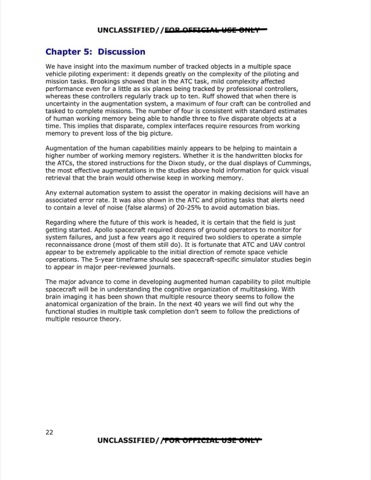
Image from page 27 of DOW-UAP-D151, as released by war.gov
Image from page 27 of the PDF. Open the scan to see the whole page.

Cite this page

U.S. Department of War. "AAWSAP DIRD, Cognitive Limits on Simultaneous Control of Multiple Unmanned Spacecraft, December 2010" (DOW-UAP-D151). PURSUE Release 06, U.S. Department of War, September 18, 2026. https://www.war.gov/medialink/ufo/sept-18/release-06/assets/DOW-UAP-D151_AAWSAP-DIRD-Cognitive-Limits-on-Simultaneous-Control-of-Multiple-Unmanned-Spacecraft-December-15-2010.pdf. Declassified UAP, page 27, https://declassifieduap.org/r/dow-uap-d151-aawsap-dird-cognitive-limits-on-simultaneous-control-of-multiple-unmanned-spacecraft-december-2010/p/27. Accessed November 28, 2026.

This address shows page 27 on its own; /r/dow-uap-d151-aawsap-dird-cognitive-limits-on-simultaneous-control-of-multiple-unmanned-spacecraft-december-2010?page=27 opens the same page in the full reader. Both stay. How to cite.