DOW-UAP-D151

AAWSAP DIRD, Cognitive Limits on Simultaneous Control of Multiple Unmanned Spacecraft, December 2010, page 21

One page of a U.S. government record released under PURSUE, shown on its own with its text. The record page has the whole document, its catalog details and the scan.

Page
21 of 31
Agency
Department of War
Released
Release 06, September 18, 2026

Text of page 21

UNCLASSIFIED//FOR 0I - USE ONLY Decision Time (sec) Intensity < Task load ÷ Processing Rate (bits) (bits•sec-1) associated with Task Difficulty decreases increases Drives Adaptation. Effort increases Decision Time ) ÷ Time available → Time pressure (sec) (sec) Time States: Fatigue Motive Anxiety... etc. Figure 5. Information Processing Model for a Human Operator. 37 In modeling the controllers themselves, one can look to selection efforts and find which candidate skills are the best predictors of training success. Pre-strike data (see footnote h on page 9) of ATC training showed that strong candidates had skills in spatial relations, abstract reasoning, and math as well as oral decision-making, 38 In designing a model, it is tempting to engage subject matter experts (SME) to estimate the demand of various resources within a multiple resource model of ATC. Cohen studied SME predictions of workload within a model of 7 channels (visual perception, auditory perception, spatial information processing, analytical information processing, verbal information processing, manual activity and speech). The authors concluded that using the 7-channel multiple resource model with the SME approach doesn't work for predicting workload in the ATC task. 39 Hancock has written extensively on the multiple-resource model of cognitive task performance under stress. He points out that functional brain imaging studies clearly show resources are separated anatomically, providing evidence that the multiple resource model should not be abandoned in future research. 40 One model that was proposed was that local visual distractions interfered with cockpit ATC tasks. The model has attractiveness given the incredible complexity of cockpit displays and the popular notion that in-vehicle distraction is the root of all evil for automobile driving. Iona proposed that a tunnel display for in-cockpit ATC information would reduce the effect of outside visual distraction and increase primary task performance measures. The authors concluded that this type of augmentation has little effect on trained professional pilots in performance of their duties. 41 16 UNCLASSIFIED//FOR OFFICIAL USE ONLY

Machine-read (OCR) from the scan by this archive; it can contain errors. The scan is the record.
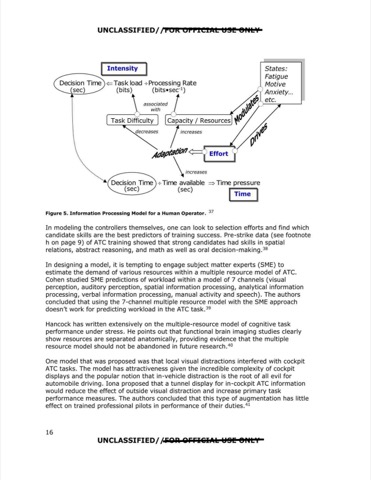
Image from page 21 of DOW-UAP-D151, as released by war.gov
Image from page 21 of the PDF. Open the scan to see the whole page.

Cite this page

U.S. Department of War. "AAWSAP DIRD, Cognitive Limits on Simultaneous Control of Multiple Unmanned Spacecraft, December 2010" (DOW-UAP-D151). PURSUE Release 06, U.S. Department of War, September 18, 2026. https://www.war.gov/medialink/ufo/sept-18/release-06/assets/DOW-UAP-D151_AAWSAP-DIRD-Cognitive-Limits-on-Simultaneous-Control-of-Multiple-Unmanned-Spacecraft-December-15-2010.pdf. Declassified UAP, page 21, https://declassifieduap.org/r/dow-uap-d151-aawsap-dird-cognitive-limits-on-simultaneous-control-of-multiple-unmanned-spacecraft-december-2010/p/21. Accessed November 28, 2026.

This address shows page 21 on its own; /r/dow-uap-d151-aawsap-dird-cognitive-limits-on-simultaneous-control-of-multiple-unmanned-spacecraft-december-2010?page=21 opens the same page in the full reader. Both stay. How to cite.