Text of page 16
UNCLASSIFIED/ /FOR OF
AL USE ONLY
Lamoureaux researched in 1999 whether a proposed ATC augmentation system could
safely allow smaller distances between aircraft and thus increase traffic capacity
without building new airports or runways. Pairs of aircraft were characterized based on
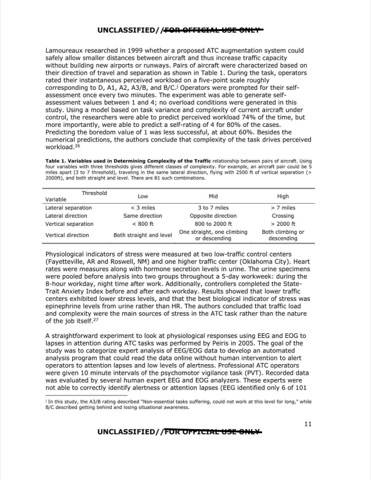
their direction of travel and separation as shown in Table 1. During the task, operators
rated their instantaneous perceived workload on a five-point scale roughly
corresponding to D, A1, A2, A3/B, and B/C./ Operators were prompted for their self-
assessment once every two minutes. The experiment was able to generate self-
assessment values between 1 and 4; no overload conditions were generated in this
study. Using a model based on task variance and complexity of current aircraft under
control, the researchers were able to predict perceived workload 74% of the time, but
more importantly, were able to predict a self-rating of 4 for 80% of the cases.
Predicting the boredom value of 1 was less successful, at about 60%. Besides the
numerical predictions, the authors conclude that complexity of the task drives perceived
workload.26
Table 1. Variables used in Determining Complexity of the Traffic relationship between pairs of aircraft. Using
four variables with three thresholds gives different classes of complexity. For example, an aircraft pair could be 5
miles apart (3 to 7 threshold), traveling in the same lateral direction, flying with 2500 ft of vertical separation (>
2000ft), and both straight and level. There are 81 such combinations.
Threshold
Low
Variable
Lateral separation
Lateral direction
Vertical separation
< 3 miles
Same direction
< 800 ft
Vertical direction
Both straight and level
Mid
3 to 7 miles
Opposite direction
800 to 2000 ft
One straight, one climbing
or descending
High
> 7 miles
Crossing
> 2000 ft
Both climbing or
descending
Physiological indicators of stress were measured at two low-traffic control centers
(Fayetteville, AR and Roswell, NM) and one higher traffic center (Oklahoma City). Heart
rates were measures along with hormone secretion levels in urine. The urine specimens
were pooled before analysis into two groups throughout a 5-day workweek: during the
8-hour workday, night time after work. Additionally, controllers completed the State-
Trait Anxiety Index before and after each workday. Results showed that lower traffic
centers exhibited lower stress levels, and that the best biological indicator of stress was
epinephrine levels from urine rather than HR. The authors concluded that traffic load
and complexity were the main sources of stress in the ATC task rather than the nature
of the job itself.27
A straightforward experiment to look at physiological responses using EEG and EOG to
lapses in attention during ATC tasks was performed by Peiris in 2005. The goal of the
study was to categorize expert analysis of EEG/EOG data to develop an automated
analysis program that could read the data online without human intervention to alert
operators to attention lapses and low levels of alertness. Professional ATC operators
were given 10 minute intervals of the psychomotor vigilance task (PVT). Recorded data
was evaluated by several human expert EEG and EOG analyzers. These experts were
not able to correctly identify alertness or attention lapses (EEG identified only 6 of 101
1 In this study, the A3/B rating described "Non-essential tasks suffering, could not work at this level for long," while
B/C described getting behind and losing situational awareness.
11
UNCLASSIFIED//FOR OFFICIAL USE ONLY