DOW-UAP-D150

AAWSAP DIRD, Quantum Computing and Utilizing Organic Molecules in Automation Technology, December 2010, page 43

One page of a U.S. government record released under PURSUE, shown on its own with its text. The record page has the whole document, its catalog details and the scan.

Page
43 of 54
Agency
Department of War
Released
Release 06, September 18, 2026

Text of page 43

UNCLASSIFIED / LEOR OI USE ONLT enzymes, e.g., deoxyribozymes, and performed either solution phase conformational changes, or were proposed to move autonomously along a linear track over up to four steps. (127) A new paper published in the journal Nano Letters details how the researchers created the first light-powered nanomotor (Figure 24) out of a photoreactive chemical and a short length -- only 31 base pairs -- of DNA. (128) The motor looks a bit like a pair of tweezers. When UV light hits it, the photoreactive chemical causes the DNA to bend, which acts as the power stroke of the motor, opening the tweezers. Light in the visible spectrum, in turn, resets the chemical, closing the tweezers. The team from the University of Florida built a new type of "molecular nanomotor" driven only by photons, or particles of light. While it is not the first photon-driven nanomotor, the almost infinitesimal device is the first built entirely with a single molecule of DNA, offering a simplicity that increases its potential for development, manufacture and real-world applications in areas ranging from medicine to manufacturing. In the coming years, nanomotors could become a component of microscopic devices that repair individual cells or fight viruses or bacteria. Although in the conceptual stage, those devices, like much larger ones, will require a power source to function. Because it is made of DNA, the nanomotor is biocompatible. Unlike traditional energy systems, the nanomotor also produces no waste when it converts light energy into motion. Azobenzene S FAM-CCT AGC TCT AAA TCA CTA TGG TCG CGC TAG G-Dabey!? 5' Stem 3' Stem Loop Figure 24. A single molecule DNA-based nanomotor driven by photons. (128) Nanomotors can be daisy-chained together, so that small movements on the microscopic scale add up to large movements at the macroscopic scale. In biology, muscle contraction and plant movement both result from small motors working together to create big changes. Scientists are attempting to mimic the many molecular motors that have been proven in nature. Today, biology is acting as a blueprint for the development of many DNA-based devices. One such biologically based mechanism is the spider-like-inspired nanowalker. 42 UNCLASSIFIED / /FOR OFFICIAL USE ONLY

Machine-read (OCR) from the scan by this archive; it can contain errors. The scan is the record.
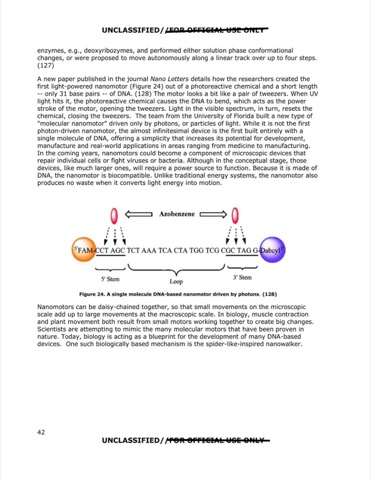
Image from page 43 of DOW-UAP-D150, as released by war.gov
Image from page 43 of the PDF. Open the scan to see the whole page.

Cite this page

U.S. Department of War. "AAWSAP DIRD, Quantum Computing and Utilizing Organic Molecules in Automation Technology, December 2010" (DOW-UAP-D150). PURSUE Release 06, U.S. Department of War, September 18, 2026. https://www.war.gov/medialink/ufo/sept-18/release-06/assets/DOW-UAP-D150_AAWSAP-DIRD-Quantum-Computing-and-Utilizing-Organic-Molecules-in-Automation-Technology-December-10-2010.pdf. Declassified UAP, page 43, https://declassifieduap.org/r/dow-uap-d150-aawsap-dird-quantum-computing-and-utilizing-organic-molecules-in-automation-technology-december-2010/p/43. Accessed November 28, 2026.

This address shows page 43 on its own; /r/dow-uap-d150-aawsap-dird-quantum-computing-and-utilizing-organic-molecules-in-automation-technology-december-2010?page=43 opens the same page in the full reader. Both stay. How to cite.