Text of page 41
UNCLASSIFIED//FOR OI
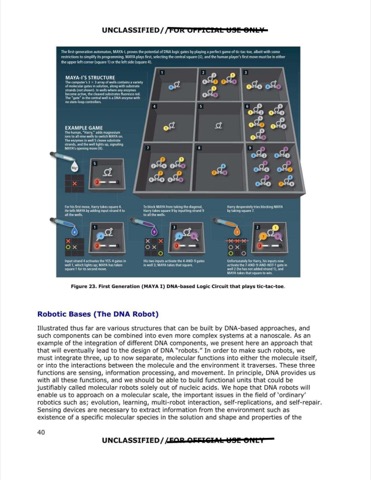
The first-generation automaton, MAYA-I, proves the potential of DNA logic gates by playing a perfect game of tic-tac-toe, albeit with some
restrictions to simplify its programming. MAYA plays first, selecting the central square (5), and the human player's first move must be in either
the upper left corner (square 1) or the left side (square 4).
MAYA-I'S STRUCTURE
The computer's 3 × 3 array of wells contains a variety
of molecular gates in solution, along with substrate
strands (not shown). In wells where any enzymes
become active, the cleaved substrates fluoresce red.
The "gate" in the central well is a DNA enzyme with
no stem-loop controllers.
EXAMPLE GAME
The human, Harry, adds magnesium
ions to all nine wells to switch MAYA on.
The enzymes in well 5 cleave substrate
strands, and the well lights up, signaling
MAYA's opening move (X).
2-
=6
For his first move, Harry takes square 4.
He tells MAYA by adding input strand 4 to
all the wells.
To block MAYA from taking the diagonal,
Harry takes square 9 by inputting strand 9
to all the wells.
Harry desperately tries blocking MAYA
by taking square 7.
***
Input strand 4 activates the YES-4 gates in
well 1, which lights up; MAYA has taken
square 1 for its second move.
His two inputs activate the 4-AND-9 gates
in well 3; MAYA takes that square.
Unfortunately for Harry, his inputs now
activate the 7-AND-9-AND-NOT-1 gate in
well 2 (he has not added strand 1), and
MAYA takes that square to win.
Figure 23. First Generation (MAYA I) DNA-based Logic Circuit that plays tic-tac-toe.
Robotic Bases (The DNA Robot)
Illustrated thus far are various structures that can be built by DNA-based approaches, and
such components can be combined into even more complex systems at a nanoscale. As an
example of the integration of different DNA components, we present here an approach that
that will eventually lead to the design of DNA "robots." In order to make such robots, we
must integrate three, up to now separate, molecular functions into either the molecule itself,
or into the interactions between the molecule and the environment it traverses. These three
functions are sensing, information processing, and movement. In principle, DNA provides us
with all these functions, and we should be able to build functional units that could be
justifiably called molecular robots solely out of nucleic acids. We hope that DNA robots will
enable us to approach on a molecular scale, the important issues in the field of 'ordinary'
robotics such as; evolution, learning, multi-robot interaction, self-replications, and self-repair.
Sensing devices are necessary to extract information from the environment such as
existence of a specific molecular species in the solution and shape and properties of the
40
UNCLASSIFIED / /EOR OFFICIAL USE ONLY