DOW-UAP-D150

AAWSAP DIRD, Quantum Computing and Utilizing Organic Molecules in Automation Technology, December 2010, page 29

One page of a U.S. government record released under PURSUE, shown on its own with its text. The record page has the whole document, its catalog details and the scan.

Page
29 of 54
Agency
Department of War
Released
Release 06, September 18, 2026

Text of page 29

UNCLASSIFIED//FO SE ONLY Figure 12 (continued). (top a-e) The XOR Cellular Automaton and Its Implementation by Tile-Based Self-Assembly. (bottom a-e) AFM Images of Algorithmic Self-assembly of Sierpinski Triangle Crystals. In theory, this process allows scientists the ability to build a computer from nanoscale material with DNA tiles (95). The experimental success of this trial demonstrated that 2D algorithmic self-assembly offers new capabilities for computation and construction, as well as a new range of physical phenomena and experimental challenges as well. Error Suppression Mechanisms in DNA Self-Assembly Molecular self-assembly is an emerging technology that will ultimately enable the fabrication of great quantities of complex nanoscale objects such as computer circuits at very low costs. Because the DNA-tile-based bottom-up assembly technique relies on the logic of programming self-assembly, it requires a situation where sticky-end binding specificity is infallible. Realistically, however, correctness of matching between tiles cannot be guaranteed due to the thermodynamics and kinetics of DNA tile self-assembly. This process alone results in occasional erroneous assembly steps. The number of assembly errors increases with the number of tile types, and accruing errors render large scale complex computation practically infeasible. Assembly errors can be classified into three types: 1.) Growth errors. 2. Facet errors. 3.) Nucleation errors. Growth and facet errors are the errors that occur on the growth front of an existing assembly, while nucleation errors deal with the spurious initiation of assemblies. A growth error occurs when a DNA tile with one or more mismatched sticky ends is embedded in the assembly. A facet error occurs on the flat surface (facet) of the aggregate when two DNA tiles attach on a growth front (facet) side by side, and thus stabilize each other's binding. This is considered an error because the identity of these tiles may not be correct with respect to the computation being performed. Nucleation errors are similar to facet errors in that a number of tiles spontaneously assemble a cluster by stabilizing each other through 28 UNCLASSIFIED//FOR OF CIAL USE ONLY

Machine-read (OCR) from the scan by this archive; it can contain errors. The scan is the record.
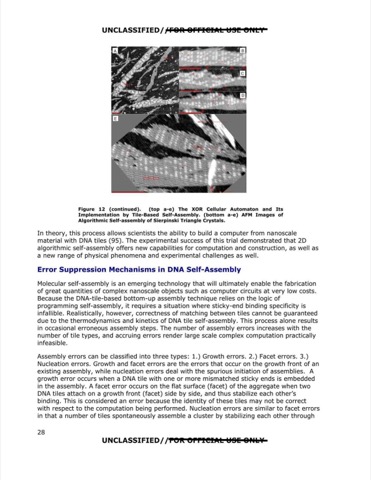
Image from page 29 of DOW-UAP-D150, as released by war.gov
Image from page 29 of the PDF. Open the scan to see the whole page.

Cite this page

U.S. Department of War. "AAWSAP DIRD, Quantum Computing and Utilizing Organic Molecules in Automation Technology, December 2010" (DOW-UAP-D150). PURSUE Release 06, U.S. Department of War, September 18, 2026. https://www.war.gov/medialink/ufo/sept-18/release-06/assets/DOW-UAP-D150_AAWSAP-DIRD-Quantum-Computing-and-Utilizing-Organic-Molecules-in-Automation-Technology-December-10-2010.pdf. Declassified UAP, page 29, https://declassifieduap.org/r/dow-uap-d150-aawsap-dird-quantum-computing-and-utilizing-organic-molecules-in-automation-technology-december-2010/p/29. Accessed November 28, 2026.

This address shows page 29 on its own; /r/dow-uap-d150-aawsap-dird-quantum-computing-and-utilizing-organic-molecules-in-automation-technology-december-2010?page=29 opens the same page in the full reader. Both stay. How to cite.