DOW-UAP-D150

AAWSAP DIRD, Quantum Computing and Utilizing Organic Molecules in Automation Technology, December 2010, page 27

One page of a U.S. government record released under PURSUE, shown on its own with its text. The record page has the whole document, its catalog details and the scan.

Page
27 of 54
Agency
Department of War
Released
Release 06, September 18, 2026

Text of page 27

UNCLASSIFIED//FOR . USE ONLY (a) (d) (b) (e) (c) (f) Figure 11. Two symmetric DNA nanomotifs and the crystals grown using them. (a) and (d) show a symmetric cross motif and a three-point-star motif, respectively. Images (b) and (e) are atomic force micrographs showing the crystal structure, and (c) and (f) are fluorescence microscopy images of DNA 2D crystals assembled from the DNA motifs (86). 8. Another widely accepted bottom up method to construct DNA nanosystems is through a process known as strand displacement or branched migration. This assembly method displaces one DNA strand and selectively replaces it with a strong complementary strand which usually consists of more Watson Crick base pairs. This method can be utilized to correct sequence errors made during strand synthesis and DNA tile assembly and in complex logic gates, and for controlling DNA motors. In 1996, Winfree devised a theoretical proposal that addressed how crystal morphology and patterning can be programmed by tile design in an inherently asynchronous assembly process, in which it was addressed by the abstract Tile Assembly Model (aTAM). (90) Winfree explored how physical parameters, such as tile concentration and temperature, affect crystal growth and influence error rates, based on reversible tile association and dissociation rates (91). This work was built on previous efforts by Wang's (92)(93) embedding of computation in geometrical tiles showing that two-dimensional (2D) self-assembly of DNA can perform Turing-universal computation. This implies that any algorithm can in principle be embedded in, and guide, a potentially aperiodic crystallization process. In this "algorithmic self- assembly" paradigm, a set of molecular "Wang tiles" is viewed as the program for a particular computation or molecular fabrication task. Later collaboration between Winfree and Seeman resulted in the first successful fabrication of a two-dimensional DNA lattice structure that utilized the mathematical principle of tiling (94). The self named DX (double crossover) molecule has two double helical motifs that are rigidly bound together by several single strands that are organized in a double crossover pattern forming a rigid structure of DNA. These DNA strands are oriented in a parallel direction. This method allows for the production of DNA based lattices by exploiting the use of sticky ends at four ends. These ends can then be further constructed to build up a scaffold of DNA based on 26 UNCLASSIFIED / /EOR IAL USE ONLY

Machine-read (OCR) from the scan by this archive; it can contain errors. The scan is the record.
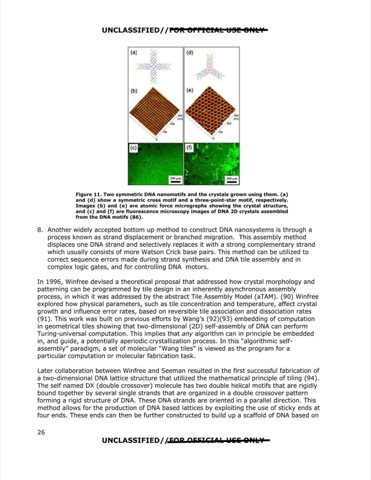
Image from page 27 of DOW-UAP-D150, as released by war.gov
Image from page 27 of the PDF. Open the scan to see the whole page.

Cite this page

U.S. Department of War. "AAWSAP DIRD, Quantum Computing and Utilizing Organic Molecules in Automation Technology, December 2010" (DOW-UAP-D150). PURSUE Release 06, U.S. Department of War, September 18, 2026. https://www.war.gov/medialink/ufo/sept-18/release-06/assets/DOW-UAP-D150_AAWSAP-DIRD-Quantum-Computing-and-Utilizing-Organic-Molecules-in-Automation-Technology-December-10-2010.pdf. Declassified UAP, page 27, https://declassifieduap.org/r/dow-uap-d150-aawsap-dird-quantum-computing-and-utilizing-organic-molecules-in-automation-technology-december-2010/p/27. Accessed November 28, 2026.

This address shows page 27 on its own; /r/dow-uap-d150-aawsap-dird-quantum-computing-and-utilizing-organic-molecules-in-automation-technology-december-2010?page=27 opens the same page in the full reader. Both stay. How to cite.