DOW-UAP-D150

AAWSAP DIRD, Quantum Computing and Utilizing Organic Molecules in Automation Technology, December 2010, page 24

One page of a U.S. government record released under PURSUE, shown on its own with its text. The record page has the whole document, its catalog details and the scan.

Page
24 of 54
Agency
Department of War
Released
Release 06, September 18, 2026

Text of page 24

UNCLASSIFIED//FOR 0 IAL USE ONLY temperature, some materials such as copper form a lattice that allows electrons to pair and flow as a bosonic charged (2e) particle. The components of superconducting circuits can be fabricated with current technology; however, decoherence times are limited to several microseconds maximum due to the large size (100 micrometers) of the circuit elements and thus large number of charge carriers in a qubit device (~1010). Additionally, the current qubit device designs only operate at the scale of 10's of mK. Superconducting elements, specifically Josephson junctions, may play a role in hybrid designs such as the distributed ion traps of Haffner (81), but are currently not seen as a stand-alone technology for quantum computation. DNA-BASED DESIGNS FOR MOLECULAR COMPUTERS While traditional silicon-based circuits reach their fundamental atomic limitation, researchers search for alternative mediums for computation. The most logical solution to overcome this restriction in silicon-based integrated circuit architectures resides within our own bodies, deoxyribonucleic acid (DNA). Living organisms also carry out complex physical processes under the direction of digital information. Biochemical reactions and ultimately an entire organism's operation are ruled by instructions stored in its genome, encoded in sequences of nucleic acids. When the workings of bimolecular machines inside cells that process DNA and RNA are compared to Turing's machine, striking similarities emerge: both systems process information stored in a string of symbols taken from a fixed alphabet, and both operate by moving step by step along those strings, modifying or adding symbols according to a given set of rules. Set strand 'Open' Waste 'Closed' Unset strand Figure 9. A DNA nanomachine driven by repeated sequential addition of DNA control strands (82). DNA Background Watson and Crick may have never realized the full potential of the double helical structure they identified nearly 60 years ago, (83) for little was known about this amazing molecule that harnesses life. Biochemists in the late nineteenth century had found that these nucleic acids, long-chain polymers of nucleotides, were made up of sugar, phosphoric acid, and 23 UNCLASSIFIED// FOR OFFICIAL USE ONLY

Machine-read (OCR) from the scan by this archive; it can contain errors. The scan is the record.
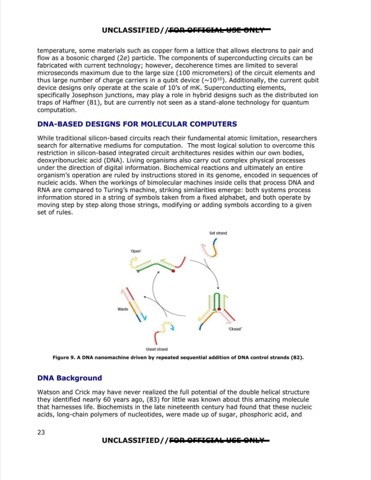
Image from page 24 of DOW-UAP-D150, as released by war.gov
Image from page 24 of the PDF. Open the scan to see the whole page.

Cite this page

U.S. Department of War. "AAWSAP DIRD, Quantum Computing and Utilizing Organic Molecules in Automation Technology, December 2010" (DOW-UAP-D150). PURSUE Release 06, U.S. Department of War, September 18, 2026. https://www.war.gov/medialink/ufo/sept-18/release-06/assets/DOW-UAP-D150_AAWSAP-DIRD-Quantum-Computing-and-Utilizing-Organic-Molecules-in-Automation-Technology-December-10-2010.pdf. Declassified UAP, page 24, https://declassifieduap.org/r/dow-uap-d150-aawsap-dird-quantum-computing-and-utilizing-organic-molecules-in-automation-technology-december-2010/p/24. Accessed November 28, 2026.

This address shows page 24 on its own; /r/dow-uap-d150-aawsap-dird-quantum-computing-and-utilizing-organic-molecules-in-automation-technology-december-2010?page=24 opens the same page in the full reader. Both stay. How to cite.