DOW-UAP-D150

AAWSAP DIRD, Quantum Computing and Utilizing Organic Molecules in Automation Technology, December 2010, page 19

One page of a U.S. government record released under PURSUE, shown on its own with its text. The record page has the whole document, its catalog details and the scan.

Page
19 of 54
Agency
Department of War
Released
Release 06, September 18, 2026

Text of page 19

UNCLASSIFIED// FOR OFFICIAL USE ONLY Top Gate: VTG 10 mm. SiOr 1 am SiO: VIls 10 mm SiO? VBI. Bottom Gate: Vc Figure 6. Bilayer graphene tunneling device structure. Two sheets of graphene are separated by a one-nanometer thick insulating of graphene. Manipulation of Spin Qubits in Graphene Quantum Dots Relative to GaAs For universal quantum computing, single-qubit and two-qubit manipulations are necessary. Single-qubit rotations of spin qubits are naturally done by electron spin resonance (ESR) (63) and by electric- dipole-induced spin resonance (EDSR) (64). The Rabi frequency fRabi at which the qubit rotates, for instance, in the ESR experiment (65) is proportional to the electron spin g-factor, fRabi = guBBac/2h where He is the Bohr magneton and Bac the external oscillating magnetic field used to rotate the spin. Notably, the electron spin g-factor differs for different materials. In GaAs quantum dots, it has been measured to be 1g| < 0.43 (66) whereas, in graphene quantum dots, it has been determined to be close to |g| = 2. (67) Thus, it is possible to rotate the electron spin in graphene quantum dots using ESR about five times faster than in GaAs quantum dots using the same field strength of the external oscillating magnetic field. This is an important gain because all qubit manipulations need to be done fast to avoid decoherence and implement fault-tolerant quantum computing (68). Another important advantage of graphene spin qubits is related to the small band gap in graphene nanoribbons. (For a ribbon width of about 30mm, the band gap can be estimated to be of the order of 60 meV.) This fact yields additional flexibility for two-qubit operations. Two-qubit operations are usually done via the Heisenberg exchange interaction (69). The tunneling matrix element can, however, be easily tuned by increasing or decreasing the overlap of the wave functions of the electrons in the two quantum dots. In graphene or any small band gap semiconductor, this manipulation can be done in two distinct ways: either through tunneling via conduction band states (i.e., normal tunneling) or through tunneling via valence band states (i.e., Klein tunneling). This has been predicted for graphene nanoribbons and experimentally realized in carbon nanotube quantum dots in (70)(71). The most important physical consequence of this additional flexibility is the appearance of a new type of long-distance coupling between graphene spin qubits as illustrated in Figure 8. 18 UNCLASSIFIED//FOR OFFICIAL USE ©NEY

Machine-read (OCR) from the scan by this archive; it can contain errors. The scan is the record.
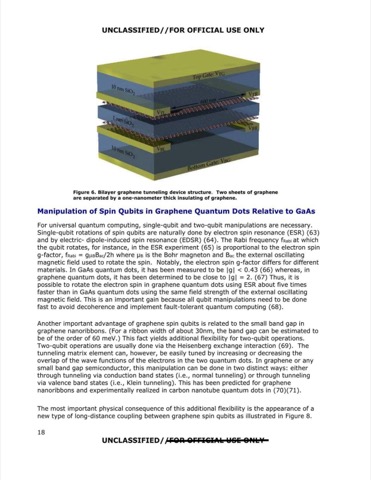
Image from page 19 of DOW-UAP-D150, as released by war.gov
Image from page 19 of the PDF. Open the scan to see the whole page.

Cite this page

U.S. Department of War. "AAWSAP DIRD, Quantum Computing and Utilizing Organic Molecules in Automation Technology, December 2010" (DOW-UAP-D150). PURSUE Release 06, U.S. Department of War, September 18, 2026. https://www.war.gov/medialink/ufo/sept-18/release-06/assets/DOW-UAP-D150_AAWSAP-DIRD-Quantum-Computing-and-Utilizing-Organic-Molecules-in-Automation-Technology-December-10-2010.pdf. Declassified UAP, page 19, https://declassifieduap.org/r/dow-uap-d150-aawsap-dird-quantum-computing-and-utilizing-organic-molecules-in-automation-technology-december-2010/p/19. Accessed November 28, 2026.

This address shows page 19 on its own; /r/dow-uap-d150-aawsap-dird-quantum-computing-and-utilizing-organic-molecules-in-automation-technology-december-2010?page=19 opens the same page in the full reader. Both stay. How to cite.