Text of page 27
UNCLASSIFIED//FOR
USE ONLT
Chapter 3: Space Applications
Electric propulsion systems are
currently being used for attitude
control, positioning, and primary
propulsion. The use of electric
propulsion systems on spacecraft
was limited by the amount of
power available. The thrusters
were developed decades before
the power systems. Early
applications were the replacement
of hydrazine monopropellant
thrusters with hydrazine resistojet
and arcjet thrusters (increasing Isp
from 200 seconds to 300 seconds
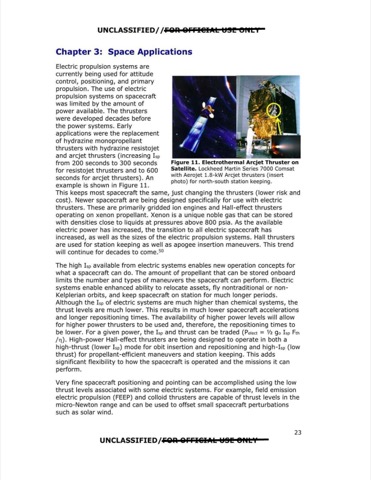
Figure 11. Electrothermal Arcjet Thruster on
for resistojet thrusters and to 600
Satellite. Lockheed Martin Series 7000 Comsat
with Aerojet 1.8-kW Arcjet thrusters (insert
seconds for arcjet thrusters). An
photo) for north-south station keeping.
example is shown in Figure 11.
This keeps most spacecraft the same, just changing the thrusters (lower risk and
cost). Newer spacecraft are being designed specifically for use with electric
thrusters. These are primarily gridded ion engines and Hall-effect thrusters
operating on xenon propellant. Xenon is a unique noble gas that can be stored
with densities close to liquids at pressures above 800 psia. As the available
electric power has increased, the transition to all electric spacecraft has
increased, as well as the sizes of the electric propulsion systems. Hall thrusters
are used for station keeping as well as apogee insertion maneuvers. This trend
will continue for decades to come. 50
The high Isp available from electric systems enables new operation concepts for
what a spacecraft can do. The amount of propellant that can be stored onboard
limits the number and types of maneuvers the spacecraft can perform. Electric
systems enable enhanced ability to relocate assets, fly nontraditional or non-
Kelplerian orbits, and keep spacecraft on station for much longer periods.
Although the Isp of electric systems are much higher than chemical systems, the
thrust levels are much lower. This results in much lower spacecraft accelerations
and longer repositioning times. The availability of higher power levels will allow
for higher power thrusters to be used and, therefore, the repositioning times to
be lower. For a given power, the Isp and thrust can be traded (Pelect = ½/ go Isp Fth
/n). High-power Hall-effect thrusters are being designed to operate in both a
high-thrust (lower Isp) mode for obit insertion and repositioning and high-Isp (low
thrust) for propellant-efficient maneuvers and station keeping. This adds
significant flexibility to how the spacecraft is operated and the missions it can
perform.
Very fine spacecraft positioning and pointing can be accomplished using the low
thrust levels associated with some electric systems. For example, field emission
electric propulsion (FEEP) and colloid thrusters are capable of thrust levels in the
micro-Newton range and can be used to offset small spacecraft perturbations
such as solar wind.
23
UNCLASSIFIED /FOR
H USE ONLY