DOW-UAP-D149

AAWSAP DIRD, MHD Air Breathing Propulsion and Power for Aerospace Applications, November 2010, page 24

One page of a U.S. government record released under PURSUE, shown on its own with its text. The record page has the whole document, its catalog details and the scan.

Page
24 of 32
Agency
Department of War
Released
Release 06, September 18, 2026

Text of page 24

UNCLASSIFIED//FeR eFFICI AL USE ONLY forebody vehicle Flow inlet Deflected streamlines Heated region Cowl lip Figure 9. Schematic of the Virtual Cowl Concept. Plasma-generated heated region upstream of the cowl lip deflects the flow and scoops more air into the inlet. Analysis of the reverse energy bypass involving MHD generator downstream of the scramjet combustor and an optimized virtual cowl revealed that, although enthalpy extraction and entropy production in the MHD generator substantially reduce the thrust, the combined system with virtual cowl can actually increase thrust by as much as 20-30%. 35, 36 From the system standpoint, this concept, with all its associated weight and complexity, should be compared with that involving a movable (variable geometry) cowl that is associated with a heavy and complex electrohydraulic system and also requires power. An attractive feature of the reverse bypass concept that might make it a winner is its multifunctional nature. Indeed, MHD power generation downstream of the combustor can be an attractive power- production option for hypersonic vehicles. Alternatives (batteries, fuel cells, and the like) are not very competitive for generation of large amounts (hundreds of kW to 1-10 MW) of power onboard. Thus, if an MHD generator in the propulsion flowpath is accepted as the power source, its operation in conjunction with a virtual cowl that significantly increases thrust in off-design conditions, and also enables aerodynamic control and maneuvering, would become quite practical. Note also that if another source of high (MW-scale) power, such as a nuclear reactor, is onboard, its use for virtual cowl, drag reduction, and aerodynamic control would be straightforward and would greatly increase performance of the hypersonic vehicle. MHD APPLICATIONS TO REENTRY AND NEAR-ORBITAL FLIGHT We now turn to MHD application to reentry and near-orbital flight. Due to the high velocities and enthalpies involved, the gas temperature in shock and boundary layers is very high, from several thousand to 10,000-20,000K. At these temperatures, thermal ionization is very substantial, and at the low end of 20 UNCLASSIFIED /FOR OFFICIAL USE ONLY

Machine-read (OCR) from the scan by this archive; it can contain errors. The scan is the record.
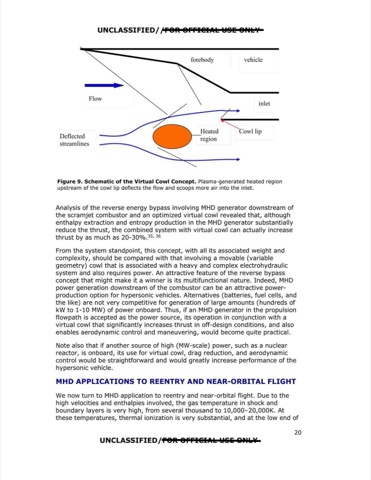
Image from page 24 of DOW-UAP-D149, as released by war.gov
Image from page 24 of the PDF. Open the scan to see the whole page.

Cite this page

U.S. Department of War. "AAWSAP DIRD, MHD Air Breathing Propulsion and Power for Aerospace Applications, November 2010" (DOW-UAP-D149). PURSUE Release 06, U.S. Department of War, September 18, 2026. https://www.war.gov/medialink/ufo/sept-18/release-06/assets/DOW-UAP-D149_AAWSAP-DIRD-MHD-Air-Breathing-Propulsion-and-Power-for-Aerospace-Applications-November-21-2010.pdf. Declassified UAP, page 24, https://declassifieduap.org/r/dow-uap-d149-aawsap-dird-mhd-air-breathing-propulsion-and-power-for-aerospace-applications-november-2010/p/24. Accessed November 28, 2026.

This address shows page 24 on its own; /r/dow-uap-d149-aawsap-dird-mhd-air-breathing-propulsion-and-power-for-aerospace-applications-november-2010?page=24 opens the same page in the full reader. Both stay. How to cite.