DOW-UAP-D149

AAWSAP DIRD, MHD Air Breathing Propulsion and Power for Aerospace Applications, November 2010, page 13

One page of a U.S. government record released under PURSUE, shown on its own with its text. The record page has the whole document, its catalog details and the scan.

Page
13 of 32
Agency
Department of War
Released
Release 06, September 18, 2026

Text of page 13

UNCLASSIFIED//FOR FUSE OTTE Electromagnetic thrusters use electromagnetic body forces (ExB) of Lorentz force to accelerate a propellant plasma as shown in Figure 4.16, 17 The electric field is applied using electrodes within the thruster. The Lorentz or ExB force accelerates both positively charged ions and negatively charged electrons or negative ions in the same direction. The magnetic field can either be applied externally (applied field thruster) or generated by a very high current (typically thousands of amps) plasma discharge (self-field thruster). The current also serves to ionize the propellant. It is the interaction of the electric and magnetic fields that pushes the plasma out of the thruster at high velocity via the Lorentz force that acts mutually perpendicular to the electric and magnetic fields. Spacecraft electromagnetic thrusters are capable of processing much higher power densities (50 kW to tens of MW) and much higher thrust densities than electrostatic thrusters (hundreds to thousands of N/m). B Uin ExB Faraday Field Orientation Lout Figure 4. Electromagnetic Accelerator Field Configuration and Self-Field Electromagnetic Spacecraft Thrusters. Left: Illustration of the electric and magnetic field configuration. Center: Photograph of a MW-class pulsed magnetoplasmadynamic (MPD) thruster being tested at Princeton University. Right: Photograph of a 50-kW steady-state MPD thruster being tested at Princeton University. An example of an air-breathing electromagnetic accelerator system for high- speed and high-altitude flight is shown in Figure 5. Air enters through the inlet on the left. The center section both accelerates the flow via electromagnetic body forces and heats the gas through Ohmic heating. The gas is then further accelerated using a diverging gas-dynamic nozzle. 9 UNCLASSIFIED /FOR OFFICIAL USE ONLY

Machine-read (OCR) from the scan by this archive; it can contain errors. The scan is the record.
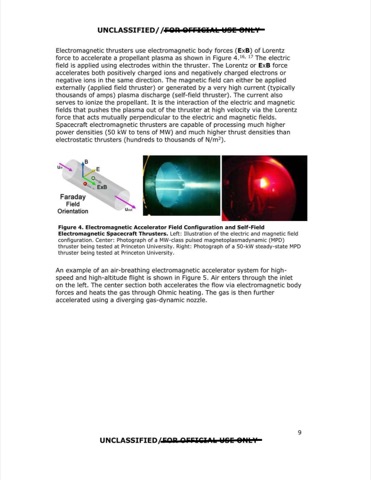
Image from page 13 of DOW-UAP-D149, as released by war.gov
Image from page 13 of the PDF. Open the scan to see the whole page.

Cite this page

U.S. Department of War. "AAWSAP DIRD, MHD Air Breathing Propulsion and Power for Aerospace Applications, November 2010" (DOW-UAP-D149). PURSUE Release 06, U.S. Department of War, September 18, 2026. https://www.war.gov/medialink/ufo/sept-18/release-06/assets/DOW-UAP-D149_AAWSAP-DIRD-MHD-Air-Breathing-Propulsion-and-Power-for-Aerospace-Applications-November-21-2010.pdf. Declassified UAP, page 13, https://declassifieduap.org/r/dow-uap-d149-aawsap-dird-mhd-air-breathing-propulsion-and-power-for-aerospace-applications-november-2010/p/13. Accessed November 28, 2026.

This address shows page 13 on its own; /r/dow-uap-d149-aawsap-dird-mhd-air-breathing-propulsion-and-power-for-aerospace-applications-november-2010?page=13 opens the same page in the full reader. Both stay. How to cite.