DOW-UAP-D149

AAWSAP DIRD, MHD Air Breathing Propulsion and Power for Aerospace Applications, November 2010, page 11

One page of a U.S. government record released under PURSUE, shown on its own with its text. The record page has the whole document, its catalog details and the scan.

Page
11 of 32
Agency
Department of War
Released
Release 06, September 18, 2026

Text of page 11

UNCLASSIFIED//FOR OfFIET AL USE ONLY pressure, Pamb is the ambient/environmental pressure, Pjet is the jet-kinetic power (thrust power) produced by the engine, and Pelect is the electrical (or other external source) power supplied to the propulsion system. For air-breathing systems the mass flow rate of the fuel is very small relative to the mass flow rate of the air. Note that an air-breathing system can never fly faster than its exhaust velocity. Rockets, because they carry an onboard oxidizer, do not have this restriction and, therefore, have no flight-speed limits. The jet power for high-speed air- breathing engines is larger than the equivalent jet power for a rocket due to the inlet and is the difference of two large numbers. Large power levels are required for aircraft and launch vehicles. For example, an SR-71 cruising at Mach 3.2 produces a thrust of 24,700 Ibf (110 kN) and a jet power of 104 MW. Climb and maneuver thrust is much higher. Similarly, an RL10 rocket engine produces 15,000 Ibf (66.7 kN) thrust at an Isp of 433 seconds, and has a jet power of 142 MW. By comparison, a Nimitz class nuclear aircraft carrier propulsion system is 194 MW, and the Hoover dam produces about 2000 MW. Therefore, any electric system replacing these applications must 30-KW Lab-Model Ammonia Ardjet Firing into a Gas-Dynamic Dittuser at JPL be capable of processing a lot of power. Spacecraft propulsion systems are typically hundreds of watts to tens of kW. This, in addition to powerplant weight issues, is a primary reason why electric propulsion systems are currently being used on spacecraft and not on aircraft. Historically, electric thrusters for spacecraft were available for flight decades before the power systems. 12 Figure 1. Electrothermal Arcjet Thruster. Photograph of a 30-kW arcjet thruster being tested at the Jet Propulsion Laboratory. 13 7 UNCLASSIFIED /FOR OFFICIAL USE ONLY-

Machine-read (OCR) from the scan by this archive; it can contain errors. The scan is the record.
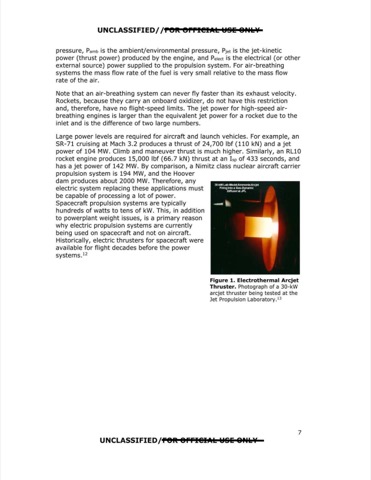
Image from page 11 of DOW-UAP-D149, as released by war.gov
Image from page 11 of the PDF. Open the scan to see the whole page.

Cite this page

U.S. Department of War. "AAWSAP DIRD, MHD Air Breathing Propulsion and Power for Aerospace Applications, November 2010" (DOW-UAP-D149). PURSUE Release 06, U.S. Department of War, September 18, 2026. https://www.war.gov/medialink/ufo/sept-18/release-06/assets/DOW-UAP-D149_AAWSAP-DIRD-MHD-Air-Breathing-Propulsion-and-Power-for-Aerospace-Applications-November-21-2010.pdf. Declassified UAP, page 11, https://declassifieduap.org/r/dow-uap-d149-aawsap-dird-mhd-air-breathing-propulsion-and-power-for-aerospace-applications-november-2010/p/11. Accessed November 28, 2026.

This address shows page 11 on its own; /r/dow-uap-d149-aawsap-dird-mhd-air-breathing-propulsion-and-power-for-aerospace-applications-november-2010?page=11 opens the same page in the full reader. Both stay. How to cite.