DOW-UAP-D148

AAWSAP DIRD, Detection and High-Resolution Tracking of Vehicles at Hypersonic Velocities, November 2010, page 7

One page of a U.S. government record released under PURSUE, shown on its own with its text. The record page has the whole document, its catalog details and the scan.

Page
7 of 46
Agency
Department of War
Released
Release 06, September 18, 2026

Text of page 7

UNCLASSIFIED FOR OFFICIAL LISE ONLY Chapter 1: Theory Governing Objects in Flight Many of the detection technologies for hypersonic aircraft are based on the properties of the air flow around the object. The fluid mechanics affecting supersonic and hypersonic aircraft are well described in textbooks on compressible flow by J.D. Anderson;2,3 subsonic flow, including the affect of boundary layers, is covered in the textbook by F. M. White.4 Hypersonic flow usually refers to the regime where objects are moving faster than Mach 5, but technically refers to the Mach range where pressure, temperature, and density ratios across shock waves reach constant values, and this does happen at about Mach 5. Fluid flow changes dramatically at Mach 1 defined at the point where the velocity of a projectile, V, equals the local speed of sound, a, in the atmosphere: V M = - (1) Flow regimes are defined by the following: • M < 1, subsonic flow • M = 1, sonic flow • M > 1, supersonic flow • M > 5, hypersonic flow The speed of sound varies with temperature and with the type of gases in the atmosphere. A simple equation for the speed of sound includes the ratio of specific heats, Y, the gas constant, R, and the temperature, T: a = VYRT (2) For air at room temperature, y = 1.4, R = 287 J/kg•K, and T = 20° C or 293 K. The subsequent speed of sound is 343 m/s (1,125 ft/s or 767 mph). It is easier for a projectile to exceed the speed of sound at higher elevations since the temperature of the atmosphere is lower, reducing the speed of sound and the subsequent velocity necessary to break the sound barrier. The viscosity of the fluid flowing around an object induces drag and retards its forward motion. Supersonic flow has some of the viscous characteristics of subsonic flow, but adds in the complication of shock waves. To understand the nature of how a projectile affects the flow of fluid around it, consider the case of a subsonic projectile. SUBSONIC FLOW AND DRAG Subsonic flows, such as the flow shown in Figure 1, are heavily influenced by collisions between molecules of air and the surface of the projectile. The equations for this interaction were first developed by Sir Isaac Newton in the seventeenth century, where he determined that fluids have a property called "viscosity" that is the cause of drag on projectiles. The key parameter that affects subsonic fluid flow is the ratio of viscous forces to inertial forces, where inertial forces are associated with the tendency for a moving fluid to keep moving in the same direction. The ratio of these two forces is defined as the Reynolds Number, Re. 3 UNCLASSIFIED//FOR OFFICIAL USE ONLY

Machine-read (OCR) from the scan by this archive; it can contain errors. The scan is the record.
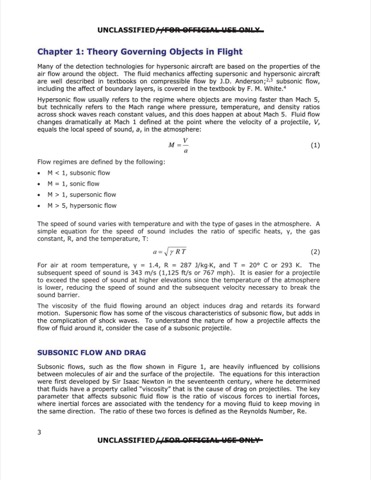
Image from page 7 of DOW-UAP-D148, as released by war.gov
Image from page 7 of the PDF. Open the scan to see the whole page.

Cite this page

U.S. Department of War. "AAWSAP DIRD, Detection and High-Resolution Tracking of Vehicles at Hypersonic Velocities, November 2010" (DOW-UAP-D148). PURSUE Release 06, U.S. Department of War, September 18, 2026. https://www.war.gov/medialink/ufo/sept-18/release-06/assets/DOW-UAP-D148_AAWSAP-DIRD-Detection-and-High-Resolution-Tracking-of-Vehicles-at-Hypersonic-Velocities-November-20-2010.pdf. Declassified UAP, page 7, https://declassifieduap.org/r/dow-uap-d148-aawsap-dird-detection-and-high-resolution-tracking-of-vehicles-at-hypersonic-velocities-november-2010/p/7. Accessed November 28, 2026.

This address shows page 7 on its own; /r/dow-uap-d148-aawsap-dird-detection-and-high-resolution-tracking-of-vehicles-at-hypersonic-velocities-november-2010?page=7 opens the same page in the full reader. Both stay. How to cite.