Text of page 29
UNCLASSIFIED FOR OF
AL USE ONLY
LIDAR can be used to detect and monitor hypersonic objects in several ways. By using a
micropulse laser, a LIDAR system could be used to scan the sky for supersonic airborne
objects. LIDAR can also detect the presence of a hypersonic vehicle by measuring the air
velocities in the long turbulent wakes that they leave in the atmosphere.
Electro Optic
Systems in Sydney, Australia,23 has announced a laser tracking system that can track objects
in low-Earth orbit that are as small as 100 mm (4 inches). These objects pose a risk to
satellites and manned space vehicles due to their high velocities (~ 8 km/s). There are an
estimated 200,000 such objects greater than 10 mm in size currently orbiting the Earth.
In the testing of hypersonic aircraft, a dedicated LIDAR system trained on the turbulent wake
could measure the temperature and velocity distribution within the wake. This information
can be used to design aircraft that would minimize detectability and increase vehicle
reliability. The U.S. Army, for example, reported on the use of a LIDAR system to monitor
atmospheric particulates from the erosion of nose-cones on Athena-H reentry missions at the
White Sands Missile Range in New Mexico in 1973.24 The LIDAR system monitored the path
of the reentry vehicles at altitudes of 9.3 km and 14.3 km and determined the concentration
of erosion products and ice particles along the laser beam path.
ACOUSTIC AND SEISMIC METHODS
Infrasound
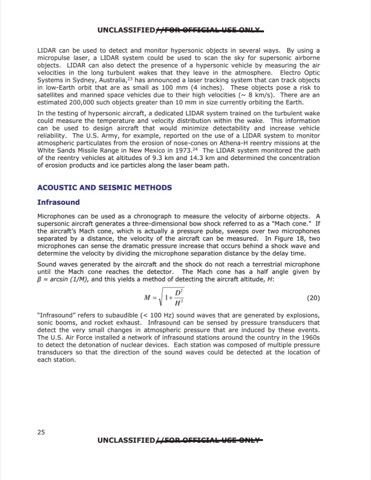
supersonic aircra generates a thre-dimension a bosure the refried to as dorma co cents. A
the aircraft's Mach cone, which is actually a pressure pulse, sweeps over two microphones
separated by a distance, the velocity of the aircraft can be measured. In Figure 18, two
microphones can sense the dramatic pressure increase that occurs behind a shock wave and
determine the velocity by dividing the microphone separation distance by the delay time.
Sound waves generated by the aircraft and the shock do not reach a terrestrial microphone
until the Mach cone reaches the detector. The Mach cone has a half angle given by
B = arcsin (1/M), and this yields a method of detecting the aircraft altitude, H:
D
M =
1+
(20)
V
H2
"Infrasound" refers to subaudible (< 100 Hz) sound waves that are generated by explosions,
sonic booms, and rocket exhaust. Infrasound can be sensed by pressure transducers that
detect the very small changes in atmospheric pressure that are induced by these events.
The U.S. Air Force installed a network of infrasound stations around the country in the 1960s
to detect the detonation of nuclear devices. Each station was composed of multiple pressure
transducers so that the direction of the sound waves could be detected at the location of
each station.
25
UNCLASSIFIED LEOR OFFICIAL USE ONLY