DOW-UAP-D148

AAWSAP DIRD, Detection and High-Resolution Tracking of Vehicles at Hypersonic Velocities, November 2010, page 25

One page of a U.S. government record released under PURSUE, shown on its own with its text. The record page has the whole document, its catalog details and the scan.

Page
25 of 46
Agency
Department of War
Released
Release 06, September 18, 2026

Text of page 25

UNCLASSIFIED FOR OFFICIAL USE ONLY #(2-micron, 597-K) 1X micron, 739 Ki** 12 14 Figure 14. Infrared Energy Spectra for Mach 3 (red line) and Mach 3.5 (blue dashed line). The peak wavelength changes for hypersonic aircraft with speeds that range from Mach 1 to Mach 100 are included in Figure 15. Satellite systems currently monitor 2.5- to 5-micron IR emissions and could detect aircraft with speeds as low as Mach 3. While Figure 15 plots the peak wavelength, aircraft at Mach 5 or higher have lower temperatures in the turbulent wake that would still be detectable. The peak temperatures are shown in Figure 16. Above 550 K, the perfect gas law cannot be used to accurately predict the peak temperature due to ionization and disassociation of molecules in the air. Figure 15 and Figure 16 use the "rule of thumb" described earlier in the theory of hypersonic vehicle flight to determine peak temperature and the corresponding wavelength. Military satellite systems monitor infrared energy emitted by objects on the surface of the Earth. Kidd and Caldwel|20 reported on the use of IR systems for defense support in 1992 and highlighted the problems in resolving missile launches and wakes from background "clutter" caused by the infrared emissions from other objects on the surface of the Earth. Typical satellite IR systems detect energy between 2 and 5 microns. To verify that an object is an actual missile, the object must be detected in the 2.6- to 3.2-micron band, which corresponds to the emission from water vapor in the hot exhaust of a rocket. It must simultaneously be identified in the 4.1- to 4.8-micron range to differentiate the missile from background clutter. One problem encountered in missile detection involves the "glint" that occurs as aircraft at high altitude passing over land at night reflects sunlight to an overhead satellite. Computer software to discriminate signals from background heat combined with detection in the two different infrared bands helps to identify actual missile launches. FLIR (forward looking infrared) is also now used for atmospheric surveillance to detect objects in the 3- to 5-micron band and in the 5- to 14-micron band. 21 UNCLASSIFIED /FOR OFFICIAL USE ONLY

Machine-read (OCR) from the scan by this archive; it can contain errors. The scan is the record.
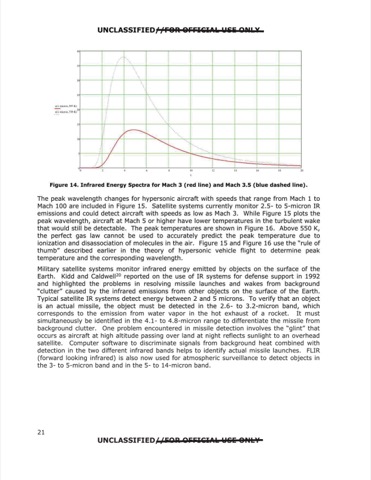
Image from page 25 of DOW-UAP-D148, as released by war.gov
Image from page 25 of the PDF. Open the scan to see the whole page.

Cite this page

U.S. Department of War. "AAWSAP DIRD, Detection and High-Resolution Tracking of Vehicles at Hypersonic Velocities, November 2010" (DOW-UAP-D148). PURSUE Release 06, U.S. Department of War, September 18, 2026. https://www.war.gov/medialink/ufo/sept-18/release-06/assets/DOW-UAP-D148_AAWSAP-DIRD-Detection-and-High-Resolution-Tracking-of-Vehicles-at-Hypersonic-Velocities-November-20-2010.pdf. Declassified UAP, page 25, https://declassifieduap.org/r/dow-uap-d148-aawsap-dird-detection-and-high-resolution-tracking-of-vehicles-at-hypersonic-velocities-november-2010/p/25. Accessed November 28, 2026.

This address shows page 25 on its own; /r/dow-uap-d148-aawsap-dird-detection-and-high-resolution-tracking-of-vehicles-at-hypersonic-velocities-november-2010?page=25 opens the same page in the full reader. Both stay. How to cite.