Text of page 11
UNCLASSIFIED+/FOR OFFICIAL USE ONLY
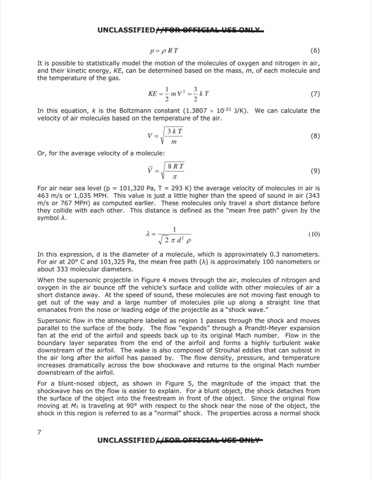
p = pRT
(6)
It is possible to statistically model the motion of the molecules of oxygen and nitrogen in air,
and their kinetic energy, KE, can be determined based on the mass, m, of each molecule and
the temperature of the gas.
KE == m V2=
- k T
(7)
In this equation, k is the Boltzmann constant (1.3807 × 10⁻²³ J/K). We can calculate the
velocity of air molecules based on the temperature of the air.
3 k 1
V=V
m
(8)
Or, for the average velocity of a molecule:
8RT
V =
П
(9)
For air near sea level (p = 101,320 Pa, T = 293 K) the average velocity of molecules in air is
463 m/s or 1,035 MPH. This value is just a little higher than the speed of sound in air (343
m/s or 767 MPH) as computed earlier. These molecules only travel a short distance before
they collide with each other. This distance is defined as the "mean free path" given by the
symbol 1.
2 =
(10)
2 n d'p
In this expression, d is the diameter of a molecule, which is approximately 0.3 nanometers.
For air at 20° C and 101,325 Pa, the mean free path (A) is approximately 100 nanometers or
about 333 molecular diameters.
When the supersonic projectile in Figure 4 moves through the air, molecules of nitrogen and
oxygen in the air bounce off the vehicle's surface and collide with other molecules of air a
short distance away. At the speed of sound, these molecules are not moving fast enough to
get out of the way and a large number of molecules pile up along a straight line that
emanates from the nose or leading edge of the projectile as a "shock wave."
Supersonic flow in the atmosphere labeled as region 1 passes through the shock and moves
parallel to the surface of the body. The flow "expands" through a Prandtl-Meyer expansion
fan at the end of the airfoil and speeds back up to its original Mach number. Flow in the
boundary layer separates from the end of the airfoil and forms a highly turbulent wake
downstream of the airfoil. The wake is also composed of Strouhal eddies that can subsist in
the air long after the airfoil has passed by. The flow density, pressure, and temperature
increases dramatically across the bow shockwave and returns to the original Mach number
downstream of the airfoil.
For a blunt-nosed object, as shown in Figure 5, the magnitude of the impact that the
shockwave has on the flow is easier to explain. For a blunt object, the shock detaches from
the surface of the object into the freestream in front of the object. Since the original flow
moving at Mi is traveling at 90° with respect to the shock near the nose of the object, the
shock in this region is referred to as a "normal" shock. The properties across a normal shock
7
UNCLASSIFIED /FOR OFFICIAL USE ONLY