DOW-UAP-D147

AAWSAP DIRD, Ultracapacitors as Energy and Power Storage Devices, November 2010, page 31

One page of a U.S. government record released under PURSUE, shown on its own with its text. The record page has the whole document, its catalog details and the scan.

Page
31 of 34
Agency
Department of War
Released
Release 06, September 18, 2026

Text of page 31

UNCLASSIFIEDT FOR OFFICH AL USE ONET In the 2020-2030 timeframe, ultracapacitor cell designs will be different. Simple plate designs, coin cells, and laminated pouches will still be used for some applications. However, advanced designs and form-factors will be used to fit specialized applications. Ultracapacitors will be designed for incorporation into chip architectures. Several options will exist for micro- and nano-electronics. Electrolyte options will most likely be different from those used today. New electrolyte solvents and better salts will be discovered that produce higher voltage cells while maintaining good ionic conductivity. Ionic liquids and complex solvents that withstand higher voltages are likely candidates. Three dimensional architectures may begin to be introduced, which will greatly improve both energy density and power density. Manufacturing techniques will enable small- and medium-format three-dimensional electrodes, where the electrical double layer is stored perpendicular to the current collector. The manufacture and assembly of large- format ultracapacitors with extremely high power capabilities will be enabled by three- dimensional architectures of nano-engineered carbons and current collectors. Beyond 2030 it is difficult to project the future developments of ultracapacitors since materials science is experiencing a nanomaterials revolution. It can be expected, however, that nearly all microelectronic circuitry will incorporate thin-film ultracaps or MCaps, and laptop computers will become the size of an iPhone with mostly voice- activated functions. As depicted in Figure 16, advancements will occur on a much faster timescale than what has happened over the last 50 years. In the energy storage area, particularly for PHEV and EV batteries, the major impact for ultracapacitors may allow not only reduced mass and size but also order-of-magnitude reduction in costs. 2010 2020 2030 2050 ULTRACAPS Figure 16. Evolution of Ultracapacitors 26 UNCLASSIFIED//FOR OFFICIAL USE-©NLY

Machine-read (OCR) from the scan by this archive; it can contain errors. The scan is the record.
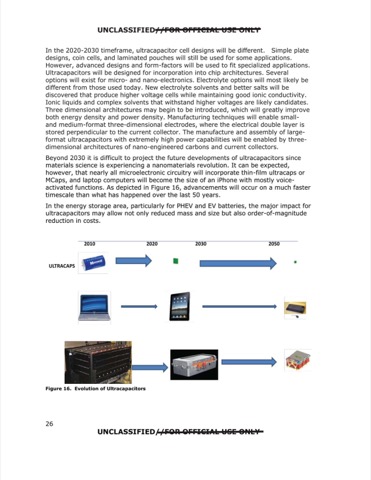
Image from page 31 of DOW-UAP-D147, as released by war.gov
Image from page 31 of the PDF. Open the scan to see the whole page.

Cite this page

U.S. Department of War. "AAWSAP DIRD, Ultracapacitors as Energy and Power Storage Devices, November 2010" (DOW-UAP-D147). PURSUE Release 06, U.S. Department of War, September 18, 2026. https://www.war.gov/medialink/ufo/sept-18/release-06/assets/DOW-UAP-D147_AAWSAP-DIRD-Ultracapacitors-as-Energy-and-Power-Storage-Devices-November-1-2010.pdf. Declassified UAP, page 31, https://declassifieduap.org/r/dow-uap-d147-aawsap-dird-ultracapacitors-as-energy-and-power-storage-devices-november-2010/p/31. Accessed November 28, 2026.

This address shows page 31 on its own; /r/dow-uap-d147-aawsap-dird-ultracapacitors-as-energy-and-power-storage-devices-november-2010?page=31 opens the same page in the full reader. Both stay. How to cite.