DOW-UAP-D147

AAWSAP DIRD, Ultracapacitors as Energy and Power Storage Devices, November 2010, page 25

One page of a U.S. government record released under PURSUE, shown on its own with its text. The record page has the whole document, its catalog details and the scan.

Page
25 of 34
Agency
Department of War
Released
Release 06, September 18, 2026

Text of page 25

UNCLASSIFIED†/FOR OFF*eI/ AL USE ONET New results 066 him dameter 0.33 nm diamet NMAC & SMAC B,C & Ti, AIC-CDCs (26 Average pore size (nm) Figure 9. Relationship Between Average Pore Size and Normalized Specific Capacitance. As the average pore size decreases below 1 nm, the specific capacitance increases due to distorted electrolyte ion solvation. THIN FILMS CNT films have been used in 2D thin-film ultracapacitors having respectable gravimetric and volumetric capacitance. Activated carbon powders have a better performance in terms of energy per unit area, 35 but they need to be processed into films before use, and this limits their choice for microdevice fabrication, which allows mass production of capacitors on semiconductor wafers. Carbide-derived carbon (CDC) is a class of carbon materials produced by selectively etching metals from metal carbides using chlorine at elevated temperatures in a process similar to current dry-etching techniques used in MEMS and microchip fabrication. CDC has been shown to have excellent performance as the active material in traditionally processed ultracaps36 since it can have its microstructure precisely tuned by tailoring the synthesis conditions for a particular electrolyte. 37 For microfabricated supercapacitors, CDC is attractive for several reasons. The precursor carbides are conductive and can be deposited in uniform thin and thick films by well-known chemical and physical vapor deposition (CVD and PVD) techniques. 38 In addition, the chlorination process can be performed at temperatures at least as low as 200°C, 39 and the resulting coatings are well-adhered with an atomically perfect interface,40 which minimizes device impedance. This technology can be used to produce the microfabricated ultracaps on the same chip as the integrated circuits, which they are powering (shown in Figure 10).41 Chlorine-containing plasma etching of materials in semiconductor manufacturing is a well-established technique and is similar to the chlorination procedure in CDC manufacturing. Continuous porous carbon films cannot be produced by conventional CVD, PVD, or other techniques, and the high-temperature activation needed to produce the microstructures necessary for ultracapacitor performance in CVD carbons would destroy the devices they were intended to power. 20 UNCLASSIFIED//FOR OFFICIAL USE-©NLY

Machine-read (OCR) from the scan by this archive; it can contain errors. The scan is the record.
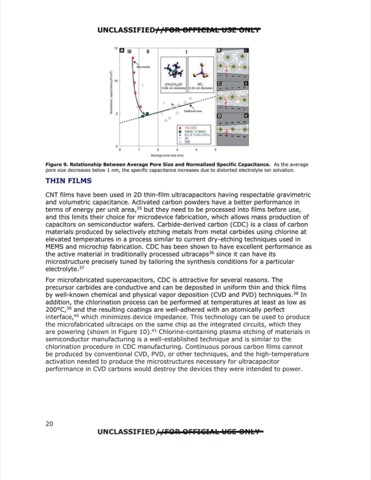
Image from page 25 of DOW-UAP-D147, as released by war.gov
Image from page 25 of the PDF. Open the scan to see the whole page.

Cite this page

U.S. Department of War. "AAWSAP DIRD, Ultracapacitors as Energy and Power Storage Devices, November 2010" (DOW-UAP-D147). PURSUE Release 06, U.S. Department of War, September 18, 2026. https://www.war.gov/medialink/ufo/sept-18/release-06/assets/DOW-UAP-D147_AAWSAP-DIRD-Ultracapacitors-as-Energy-and-Power-Storage-Devices-November-1-2010.pdf. Declassified UAP, page 25, https://declassifieduap.org/r/dow-uap-d147-aawsap-dird-ultracapacitors-as-energy-and-power-storage-devices-november-2010/p/25. Accessed November 28, 2026.

This address shows page 25 on its own; /r/dow-uap-d147-aawsap-dird-ultracapacitors-as-energy-and-power-storage-devices-november-2010?page=25 opens the same page in the full reader. Both stay. How to cite.