Text of page 23
UNCLASSIFIEDTFOR OFFIETAL USE ONLT
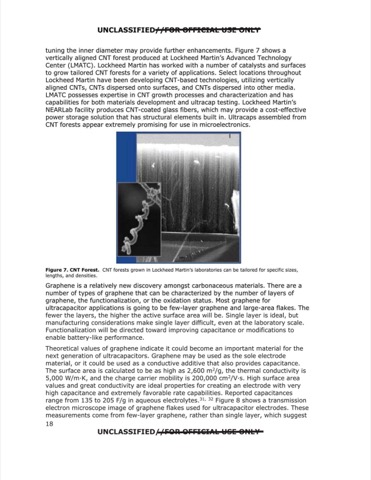
tuning the inner diameter may provide further enhancements. Figure 7 shows a
vertically aligned CNT forest produced at Lockheed Martin's Advanced Technology
Center (LMATC). Lockheed Martin has worked with a number of catalysts and surfaces
to grow tailored CNT forests for a variety of applications. Select locations throughout
Lockheed Martin have been developing CNT-based technologies, utilizing vertically
aligned CNTs, CNTs dispersed onto surfaces, and CNTs dispersed into other media.
LMATC possesses expertise in CNT growth processes and characterization and has
capabilities for both materials development and ultracap testing. Lockheed Martin's
NEARLab facility produces CNT-coated glass fibers, which may provide a cost-effective
power storage solution that has structural elements built in. Ultracaps assembled from
CNT forests appear extremely promising for use in microelectronics.
Figure 7. CNT Forest. CNT forests grown in Lockheed Martin's laboratories can be tailored for specific sizes,
lengths, and densities.
Graphene is a relatively new discovery amongst carbonaceous materials. There are a
number of types of graphene that can be characterized by the number of layers of
graphene, the functionalization, or the oxidation status. Most graphene for
ultracapacitor applications is going to be few-layer graphene and large-area flakes. The
fewer the layers, the higher the active surface area will be. Single layer is ideal, but
manufacturing considerations make single layer difficult, even at the laboratory scale.
Functionalization will be directed toward improving capacitance or modifications to
enable battery-like performance.
Theoretical values of graphene indicate it could become an important material for the
next generation of ultracapacitors. Graphene may be used as the sole electrode
material, or it could be used as a conductive additive that also provides capacitance.
The surface area is calculated to be as high as 2,600 mg, the thermal conductivity is
5,000 W/m•K, and the charge carrier mobility is 200,000 cm/V•s. High surface area
values and great conductivity are ideal properties for creating an electrode with very
high capacitance and extremely favorable rate capabilities. Reported capacitances
range from 135 to 205 F/g in aqueous electrolytes. 31, 32 Figure 8 shows a transmission
electron microscope image of graphene flakes used for ultracapacitor electrodes. These
measurements come from few-layer graphene, rather than single layer, which suggest
18
UNCLASSIFIED//FOR OFFICIAL USE ONLY