DOW-UAP-D146

AAWSAP DIRD, Aneutronic Fusion Propulsion II, November 2010, page 8

One page of a U.S. government record released under PURSUE, shown on its own with its text. The record page has the whole document, its catalog details and the scan.

Page
8 of 36
Agency
Department of War
Released
Release 06, September 18, 2026

Text of page 8

UNCLASSIFIED//FOR OFFICIAL USE ONLY Chapter 2: Fusion Plasma Physics At the most basic level, nuclear fusion occurs by forcing atomic nuclei close enough so that the attractive strong force (which binds nuclei together) overwhelms the very powerful electromagnetic repulsion force. Under such circumstances the nuclei fuse together to form a single nucleus, creating an atom of a different element (along with byproducts such as radiation and neutrons). Because the strong force dominates over such short-length scales (~10-15 meter, the diameter of a medium-sized nucleus), the fusion of heavier nuclei are inherently more unstable, with smaller binding energies. For light nuclei, the binding energies of the individual nuclei are significantly smaller than that of the fused nucleus; it is the released energy of the fusion process (in the form of high-energy photons or kinetic energy of nuclear products such as neutrons) that is sought as an energy source. Table 1 shows Fusion reactions including the relevant aneutronic fusion reactions. Table 1: Principal Fusion Reactions Main controlled fusion fuels D + T → a + n IT + p D + D → 3 He + n a + Y T + T → a + 2n Advanced fusion fuels D + 3 He → a + p p+ "Li → a + 3 He p + 7Li → 20 р + "B → 30 E (MeV) 17.59 4.04 3.27 23.85 11.33 18.35 4.02 17.35 8.68 To fuse a sufficient number of nuclei within a span of time for practical use, it is generally necessary to heat an ensemble of atoms to the very high energies shown in Table 1. These energies (temperatures) are high enough that electrons are stripped from their associated nuclei, producing a plasma of free electrons and ions. The fusion reaction cross sections (o), the probability of interaction for these reactions in barns = 10-28 m2, is shown in Figure 1. For the maximum reaction rate temperature, the ratio of the total amount of energy (kinetic plus radiation) released in the fusion reaction relative to the bremsstrahlung radiation released is shown in Table 2. 3 UNCLASSIFIED//TOR OFFICIAL USE ONLY

Machine-read (OCR) from the scan by this archive; it can contain errors. The scan is the record.
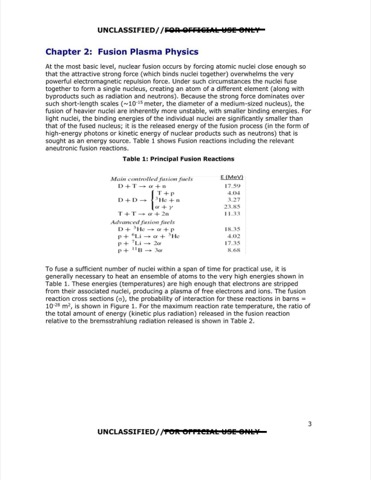
Image from page 8 of DOW-UAP-D146, as released by war.gov
Image from page 8 of the PDF. Open the scan to see the whole page.

Cite this page

U.S. Department of War. "AAWSAP DIRD, Aneutronic Fusion Propulsion II, November 2010" (DOW-UAP-D146). PURSUE Release 06, U.S. Department of War, September 18, 2026. https://www.war.gov/medialink/ufo/sept-18/release-06/assets/DOW-UAP-D146_AAWSAP-DIRD-Aneutronic-Fusion-Propulsion-II-November-1-2010.pdf. Declassified UAP, page 8, https://declassifieduap.org/r/dow-uap-d146-aawsap-dird-aneutronic-fusion-propulsion-ii-november-2010/p/8. Accessed November 28, 2026.

This address shows page 8 on its own; /r/dow-uap-d146-aawsap-dird-aneutronic-fusion-propulsion-ii-november-2010?page=8 opens the same page in the full reader. Both stay. How to cite.