DOW-UAP-D146

AAWSAP DIRD, Aneutronic Fusion Propulsion II, November 2010, page 23

One page of a U.S. government record released under PURSUE, shown on its own with its text. The record page has the whole document, its catalog details and the scan.

Page
23 of 36
Agency
Department of War
Released
Release 06, September 18, 2026

Text of page 23

UNCLASSIFIED/ FOR OFF AL USE ONLY the MeV alpha particles for the (p,"B) into a direct thrust would increase the Isp to >5,000 seconds with thrust levels >5 N/kW. - 1 kV Xenon Insulator- Accelerating Grid Plasma Jet Electron Emitters Electron Guide + 100 V Figure 13. Design of an IEC Jet Thruster - Experimental Device left INTERPLANETARY Many of the fusion reactor applications described in Chapter 3 have been specifically applied to space propulsion. The key reason for the benefits of such systems lies in the fundamentally different nature of fusion propulsion compared to chemical or nuclear- thermal propulsion. Fusion propulsion systems pay a mass penalty for carrying their power source. However, a propellant mass savings results from the high thrust per unit mass that arises from high exhaust velocity that overcomes the power-source mass penalty. These potential performance enhancements are shown in Figure 14, which illustrates fusion propulsion's capabilities for fast transport of humans or efficient transport of cargo between circular solar orbits for Earth-Mars one-way rendezvous missions. 18 In order to achieve the efficient solar system travel shown in Figure 14, propulsion systems must achieve specific powers of at least 1 kW/kg at exhaust velocities of ~105- 106 m/s, leading to thrust-to-weight ratios of ~10-3. The required range of parameters and a comparison with chemical and nuclear thermal propulsion options appears in Figure 15.19 The capability of tuning the exhaust velocity over factors of 10-100 is a desirable feature that facilitates energy intensive missions. For the same delivered payload the fraction of the propellant and nonpayload mass is significantly minimized for fusion propulsion as compared to the other propulsion options. 18 UNCLASSIFIED/ /TOR OFFTETAL USE ONLY

Machine-read (OCR) from the scan by this archive; it can contain errors. The scan is the record.
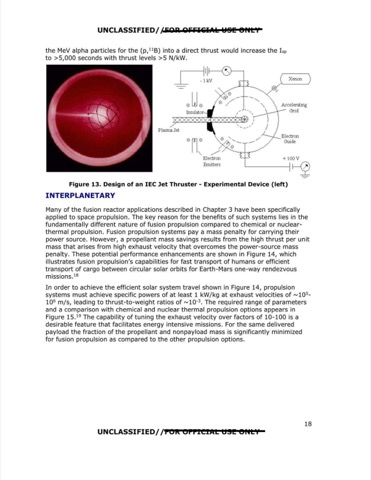
Image from page 23 of DOW-UAP-D146, as released by war.gov
Image from page 23 of the PDF. Open the scan to see the whole page.

Cite this page

U.S. Department of War. "AAWSAP DIRD, Aneutronic Fusion Propulsion II, November 2010" (DOW-UAP-D146). PURSUE Release 06, U.S. Department of War, September 18, 2026. https://www.war.gov/medialink/ufo/sept-18/release-06/assets/DOW-UAP-D146_AAWSAP-DIRD-Aneutronic-Fusion-Propulsion-II-November-1-2010.pdf. Declassified UAP, page 23, https://declassifieduap.org/r/dow-uap-d146-aawsap-dird-aneutronic-fusion-propulsion-ii-november-2010/p/23. Accessed November 28, 2026.

This address shows page 23 on its own; /r/dow-uap-d146-aawsap-dird-aneutronic-fusion-propulsion-ii-november-2010?page=23 opens the same page in the full reader. Both stay. How to cite.